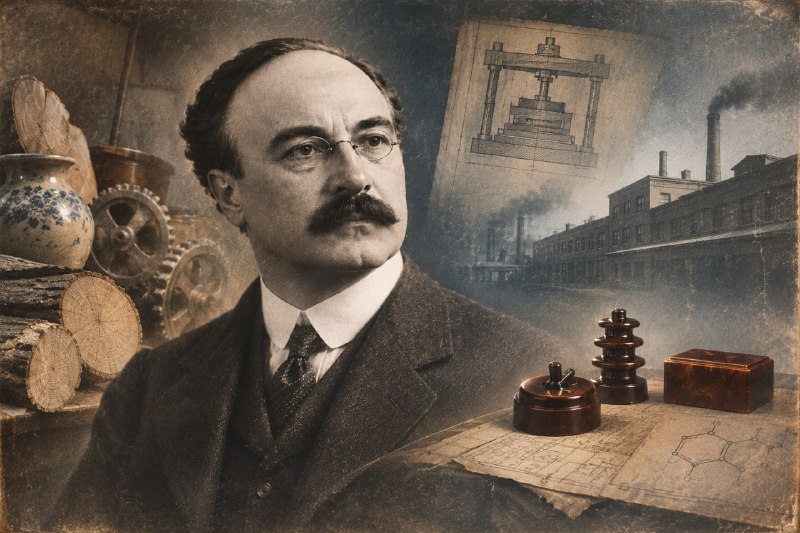
A material that did not exist in nature: how a shoemaker's son ushered in the plastic age for humanity.
Imagine a world without plastic. Telephones, radios, cars, electrical appliances - everything should be made of wood, metal, glass, ceramics and natural resin. Even a simple switch becomes an engineering challenge: its housing must be non-conductive, withstand heat, and yet be cheap enough to produce millions of parts.
Into such a world was born Leo Baekland, the man who would create the first completely synthetic plastic, on November 14, 1863.
The future inventor was born in Ghent, Belgium, in the family of a shoemaker. The father wanted his son to continue his work, but his mother insisted on his education. Leo was interested in chemistry, graduated from university and then moved to the US.
At the end of the 19th century he was already a rich man. The Velox photographic paper he developed made it possible to print photographs in artificial lighting. In 1899, the rights to it were purchased by George Eastman, the founder of Kodak. The money received provided Baekland with what almost every inventor dreams of: his own laboratory and the opportunity to experiment without thinking about making money.
However, Baekland was not only looking for a scientific discovery. He was interested in a very practical task - to create an artificial substitute for shellac, a natural resin widely used in electrical engineering. The world was electrifying rapidly, and industry needed cheap and reliable insulating materials.
In 1907, while experimenting with phenol and formaldehyde, Baekland obtained an unusual resin. At a certain combination of temperature and pressure, it became a hard and durable material that no longer softened on reheating.
It was like inventing a new type of wood that could first be cast into a mold and then become a solid part of the desired configuration.