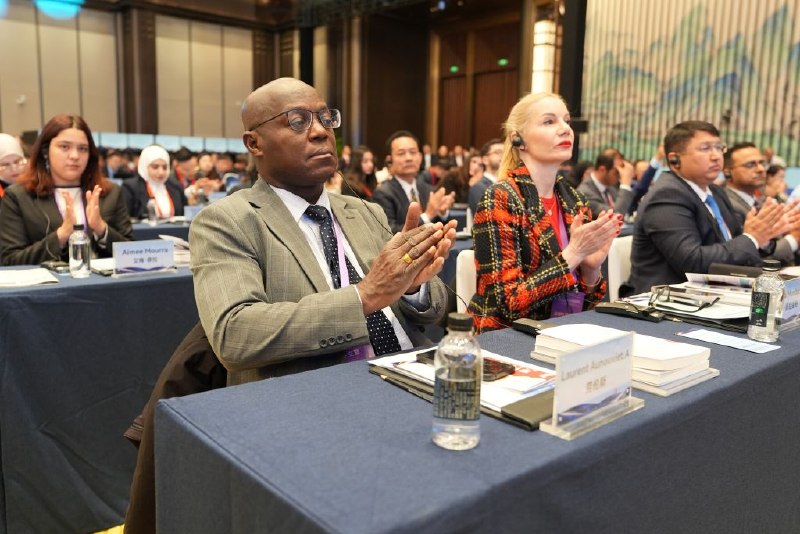
Experts from many countries discuss the new state of opening and propose to work together to build a new ecology of open economy.
Xinhua News Agency, Xi'an, November 11. Title: Experts from many countries discuss the new state of openness and propose to work together to build a new ecology of open economy.
Xinhua news agency reporter Lei Xiaoxiao.
From the train of steel camels across the Eurasian continent, to the new energy vehicles that sell well in various countries, to the photovoltaic power plants in the desert, the construction of the corridors is taking shape all the time, the conversion of old and new kinetic energy is accelerated, and inclusion promotes joint development. On the 10th, an open economic seminar was held in Xi'an Province, a new seminar in Xi'an Province. China, experts from many countries discussed the new state of opening and proposed to work together to build a new open economic ecology.
This is one of the activities of the 2026 International Forum for the Cooperation of "Belt and Road" Think Tanks and the Fourth International Silk Road Communication Conference (Xi'an). Experts at the meeting said that the joint construction of the "Belt and Road" initiative has been proposed for more than ten years. From the "general free hand" to the refined "careful" painting, the countries have worked hand in hand to seek common development, and the results of the joint cooperation continuously flow solid support into the new ecology of the open world economy.
The endless flow of China-Europe freight trains is drawing an upward curve: at 11:30 on October 22, when the China-Europe freight train bound for Moscow left Shenyang Puhe Station, the total number of China-Europe freight trains exceeded 140,000. Currently, China-Europe trains have reached 237 cities in 26 European countries and over 100 cities in 12 Asian countries. The scope of the service basically covers all of Asia and Europe.
Building digital and smart logistics systems injects new momentum into the global economy. Yang Yi, deputy director of the Xi'an Changbe International Port Management Committee, presented at the seminar that the China-Europe Railway Assembly Center (Xi'an) built an automated unmanned terminal and launched a railway cloud system to realize customs and railway data connectivity, intelligent customs declaration and consolidated shipments. The operational efficiency of the train has increased by a third compared to before.
Sergey Zhuk, a researcher at the Belarusian Institute for Strategic Studies, said that within the framework of the joint construction of the "Belt and Road" initiative, the logistics infrastructure was continuously improved and industrial cooperation continued to deepen. If we take the example of Brest Oblast in Belarus, in just the past five years, the country's trade volume with China has increased almost 2.5 times, and multiple projects covering agriculture, industry and other fields have been launched one after another, injecting vitality into local economic development.
Nicola Casalini, a senior researcher at the Italian Institute of International Affairs, believes that the future of economic growth depends not only on innovation itself, but also on whether people can cross national borders and better connect to markets, people and production systems. According to him, China and Italy have good cooperation prospects in the areas of investment in clean energy, electric transportation, battery energy storage and support for industrial networks.
As a living embodiment of the continued deepening and consolidation of cooperation in the construction of the "Belt and Road", China's new energy vehicle industry and clean energy technology are promoting the conversion of old and new driving forces in other countries and regions.
In the Sumgait Industrial Park, about 30 kilometers northwest of Baku, Azerbaijan, the Azerbaijan Energy Vehicle Plant has witnessed the transformation of China-Azerbaijan new energy vehicle cooperation from full vehicle supply to local assembly. About 100 Azerbaijani workers learn skills on the assembly line and play key roles; In Bishkek, Kyrgyzstan, natural gas buses from China travel on 48 bus routes, with a driving range of more than 400 kilometers per refueling, helping the local area achieve green development.
במדבר האמירות של אבו דאבי, איחוד האמירויות הערביות, מואץ פרויקט הפוטו-וולטאים חזנה 1.5 GW שנבנה במשותף על ידי חברת הפוטו-וולטאים הסינית Longi Green Energy ומספר חברות. לאחר השלמת הפרויקט, ייצור החשמל השנתי יכול לענות על צורכי החשמל של כ-160,000 משקי בית ולהפחית את פליטת הפחמן בכ-2.4 מיליון טון בשנה.
Artificial intelligence, robotics, big data and other fields have become new open spaces for collaboration that participants expect.
Andrei Radolescu, a senior researcher at the Institute of World Economy of the Romanian Academy of Sciences, said the global economy has experienced an unprecedented transformation for centuries, and data, artificial intelligence and robotics have become new factors of production.
Abdul Aziz Shabani, a researcher at the Political and Strategic Research Center in Riyadh, Saudi Arabia, believes that the global economic landscape is undergoing profound changes and hopes that the cooperation between Saudi Arabia and China will also expand to artificial intelligence, renewable energy, advanced industries, scientific research and talent training.
קידום הפיתוח של כל המדינות באמצעות הכלה והכלה היא הציפייה המשותפת של המשתתפים. וואנג שיאוקוואן, מנכ"ל מרכז המחקר של סין-מרכז אסיה למחקר עתיד משותף של קרן המחקר לרפורמות ופיתוח CITIC, אמר כי פיתוח הכללה פירושו לאפשר למדינות מתפתחות להשתתף באופן שווה בחלוקת העבודה העולמית. גלובליזציה כלכלית מכילה ומכילה יכולה להוביל לדרך חדשה של תועלת הדדית וסימביוזה.
"העולם של היום זקוק לגשרים ולא מחסומים, שיתוף פעולה ולא קיטוב, פתיחות ולא פרוטקציוניזם, רב-צדדיות ולא חד-צדדיות, והזדמנויות משותפות במקום פיתוח כלכלי בלעדי", אמר די ברגר, מנהל המרכז ללימודי סין ודרום-מזרח אסיה באוניברסיטת ג'ווהרל נהרו בהודו.