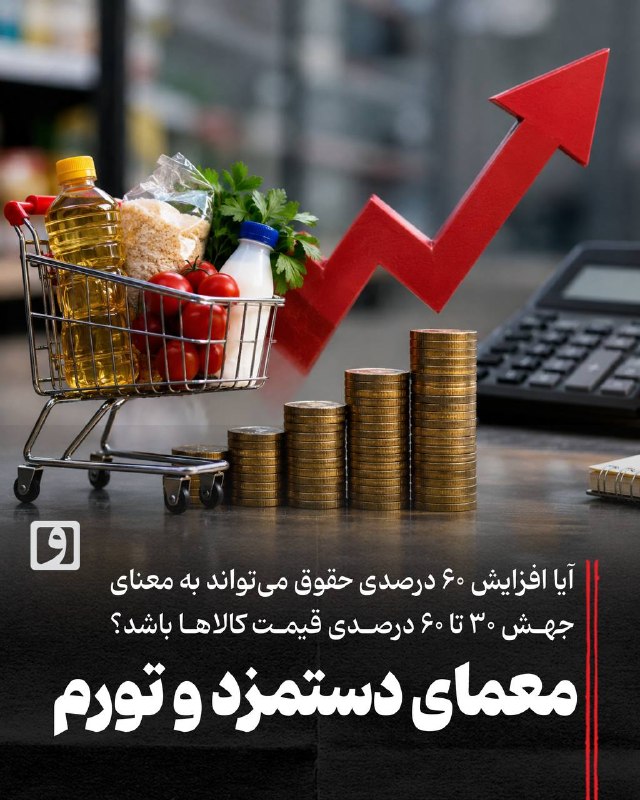
The wage and inflation puzzle; Can a 60% increase in salaries mean a 30-60% jump in the price of goods?
summary.
Muhammad Taher Rahimi: The First Vice President's statements about the inflationary effects of the 60% increase in workers' wages in 1,405 have once again made the relationship between wages and inflation an important issue in economic policy. However, making the possible relationship between wages and inflation a definite rule, regardless of the main factors of inflation, is a misunderstanding of the structure of the Iranian economy.
According to the statistics of the Iranian Statistics Center, the share of wages in the total cost of production in industrial workshops is less than 5%, and according to the Ministry of Defense's survey of 47 production and service groups, it stands at 12% on average. Thus, a 60% increase in wages, assuming other cost stability, increases total cost by only 3 and 7.2% respectively. As a result, the 30-60% price increase cannot be directly attributed to an increase in wages.
The spiral theory of wages and inflation sees the rise in prices and the demand for higher wages as a reciprocal cycle; But this theory cannot be generalized regardless of economic conditions. The existence of empty production capacities, incomplete employment, lack of demand and the reduction of household consumption in Iran show that the increase in wages can restore purchasing power, increase factory sales and lead to the growth of production and employment.
The main root of the pressure on the producers should be found in the currency fluctuations, the increase in the cost of raw materials and imported inputs, the limitation of the companies' working capital and the reduction of household consumption. On the other hand, the continuation of wage suppression leads to the expansion of informal employment, the migration of skilled workers, the reduction of savings and the weakening of the local market. Adequate wages are a necessary condition for maintaining effective demand and employment stability.
It is not possible to introduce the wage increase as the main source of inflation without calculating the share of labor in the cost of production and paying attention to the demand situation and the available capacities. Iran's economy suffers from currency instability, an increase in the cost of production inputs, a limitation of working capital and a decrease in the purchasing power of households, more than the increase in wages. The worker is not the only factor in the cost of production, but also the consumer of local products, and the suppression of wages through shrinking the sales market hinders the sustainable development of production.
Read the full text on Watan's website today.