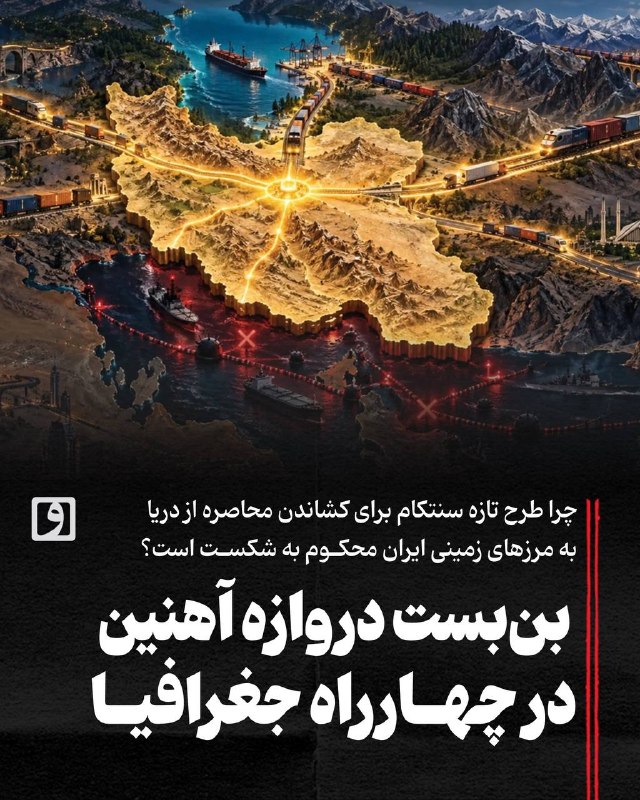
dead end of the iron gate at Gaufria intersection; Why is Centcom's new plan to extend the blockade from the sea to Iran's land borders doomed to failure?
Summary: The Central Command of the US Army announced on November 7 the establishment of the "Iron Gate" task force to identify and block Iran's equipment transfer networks and foreign exchange earnings at the land borders and the Caspian Sea. This group is located in Florida with 20 military and civilian experts, and its tools are administrative pressure, searching for information on broker companies and threats against insurance brokers.
Changing the pressure front from sea to land shows the failure of Washington's previous strategies. After trying to block oil exports from the Persian Gulf and targeting Iranian air transport, they are now focusing on land routes. However, 6,000 kilometers of land border, a neighborhood with 7 countries and access to the Caspian Sea made it possible to change the course of exchanges.
The seven communication axes of Iraq, Turkey, the Caspian Sea, the Caucasus, Central Asia, Afghanistan and Pakistan had about 22 billion dollars of trade exchange in the last two years. Iraq with $8.9 billion and Turkey with $4 billion are among the most important trade routes. Also, the northern ports, the Caucasus routes and the eastern passages play an important role in the transfer of goods.
Despite the capacity of these routes, the lack of train fleets and roads, the weakness of the port infrastructure, the non-completion of the Rasht-Astra railway and the problems of the border terminals are obstacles to the development of trade. It is necessary to strengthen the infrastructure and increase the customs capacity to maintain the stability of the exchanges.
In order to deal with the American pressure, Iran's position must be upgraded from a seller of goods to a connecting center of energy and transit networks in the region. The project to transfer Russian gas to Iran, the completion of the Rasht-Astra railway line and joint investment with China and Russia are important. Alongside the development of alternative land routes, breaking the blockade by air and water should also be on the agenda.
Read the full text on Watan's website today.