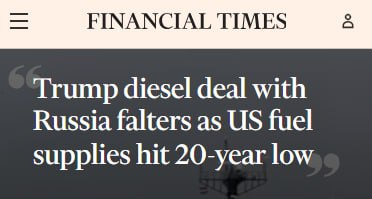
Two of the three tankers originally bound for the United States with Russian diesel changed their declared routes. The Financial Times "Diesel deal" collapses - Trump's agreement with Putin on the supply of fuel has run into legal and political obstacles, the publication reports. At the same time, US inventories of distillates, including diesel and heating oil, fell below 100 million barrels for the first time in more than 20 years. The LeRo tanker changed its stated destination from the Atlantic coast to Brazil. Talisman sailed through the Straits of Gibraltar into the Mediterranean and is now reported to be awaiting orders. These changes were recorded by the Marine Lateral Analysis Company on November 3. The third vessel, owned by the Greek owner Agioi Fanendes, continued to move towards the northeast coast of the United States. However, instead of New York, it began to indicate the automatic vessel identification system, which is awaiting further instructions. Of the three, L'Lauret estimates that only its route still allows possible unloading at a port in the US. Another problem arises from the sanctions against Leroux and Talisman. As noted later, the restrictions complicate the work not only of buyers, but also of port operators and companies servicing ships. Trump explained the agreement as a desire to increase fuel supply and lower prices for Americans. But the legality of the chosen mechanism was challenged by representatives of both parties: they pointed to the ban on the import of Russian energy resources adopted by Congress in 2022. At the same time, Kirill Dmitriev called the publication of the "Financial Times" fake according to which diesel tankers on their way to the United States changed their route: "Tankers going to the USA continue to follow their route. Why is there so much fake news from the Financial Times? " he said.
Two of the three tankers originally bound for the United States with Russian diesel changed their declared routes. The Financial Times "Diesel deal" collapses - Trump's agreement with Putin on the supply of fuel has run into legal and political obstacles, the publication reports. At the same time, US inventories of distillates, including diesel and heating oil, fell below 100 million barrels for the first time in more than 20 years. The LeRo tanker changed its stated destination from the Atlantic coast to Brazil. Talisman sailed through the Straits of Gibraltar into the Mediterranean and is now reported to be awaiting orders. These changes were recorded by the Marine Lateral Analysis Company on November 3. The third vessel, owned by the Greek owner Agioi Fanendes, continued to move towards the northeast coast of the United States. However, instead of New York, it began to indicate the automatic vessel identification system, which is awaiting further instructions. Of the three, L'Lauret estimates that only its route still allows possible unloading at a port in the US. Another problem arises from the sanctions against Leroux and Talisman. As noted later, the restrictions complicate the work not only of buyers, but also of port operators and companies servicing ships. Trump explained the agreement as a desire to increase fuel supply and lower prices for Americans. But the legality of the chosen mechanism was challenged by representatives of both parties: they pointed to the ban on the import of Russian energy resources adopted by Congress in 2022. At the same time, Kirill Dmitriev called the publication of the "Financial Times" fake according to which diesel tankers on their way to the United States changed their route: "Tankers going to the USA continue to follow their route. Why is there so much fake news from the Financial Times? " he said.
🇺🇸 USA · Map
More on Radar
Want to see every report in real time?
Hundreds of sources worldwide, translated into your language, with alerts for what matters to you.
Sign up free Already have an account? Log in