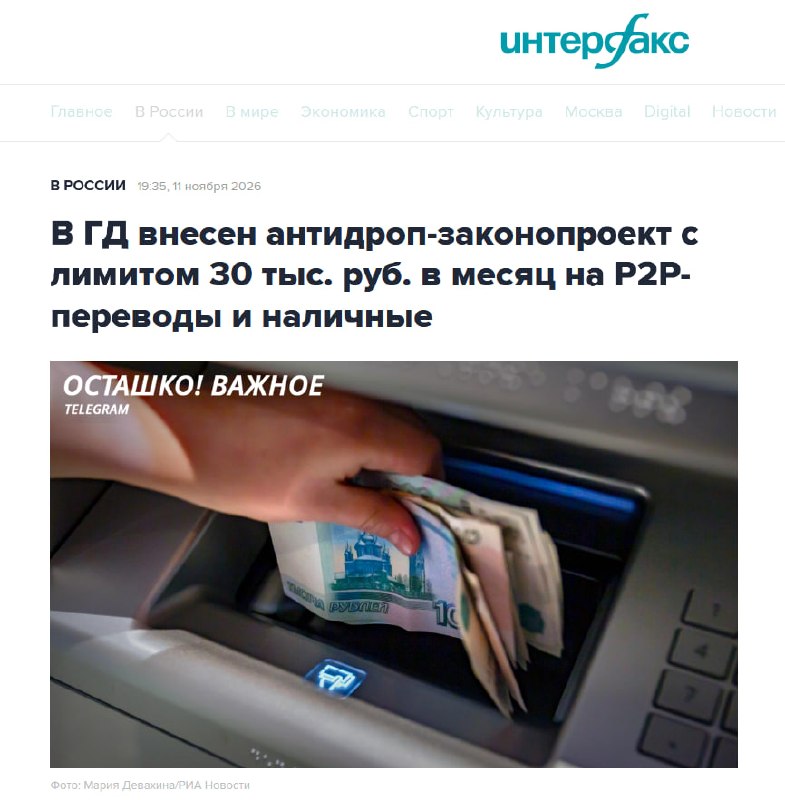
Russians can limit cash transfers and deposits to 30,000 per month.
A bill was submitted to the State Duma requiring banks to introduce a monthly limit of 30 thousand ₽ on depositing cash and receiving transfers from other citizens for customers suspected of dubious transactions. The new rules may come into effect as of March 1, 2028.
The authors of document No. 32298-9 were deputies and senators, including the head of the State Duma Committee on the Financial Market Anatoly Al-Aksakov and the Deputy Chairman of the Federation Council Nikolai Zhorvalev.
The Bank of Russia will have the right to identify customers with signs of suspicious financial transactions. The regulator will develop the criteria together with Rosfinmonitoring, and will be approved by the central bank's board of directors. The regulator will forward information about such customers to the banks and Rosfinmonitoring.
If the bank identifies transactions that are in line with the signs established by the central bank and receives information from the regulator about the client's risks, it is obliged to introduce restrictions no later than the next business day.
Initially, the restrictions will be in effect for no more than a year. If within 3 years after their cancellation the customer makes suspicious transactions again, the limit will be introduced to 2 years. Changing an account in the same bank will not help to bypass the restrictions.
The bank must inform the customer of the reasons and timing of the restrictions no later than the following business day, as well as explain the appeal procedure.
The customer will be able to provide documents confirming that there is no reason to block transactions. The bank is obliged to review them and respond within 7 working days. If he leaves the restrictions in effect, the decision can be appealed in court, but only after contacting the bank itself.
The authors of the bill explain the initiative as a fight against shady financial schemes, fraudsters, illegal crypto exchangers, illegal online casinos (which can be legalized) and drug payments.
According to them, such operations are increasingly carried out through personal accounts of citizens, splitting transfers between different banks.