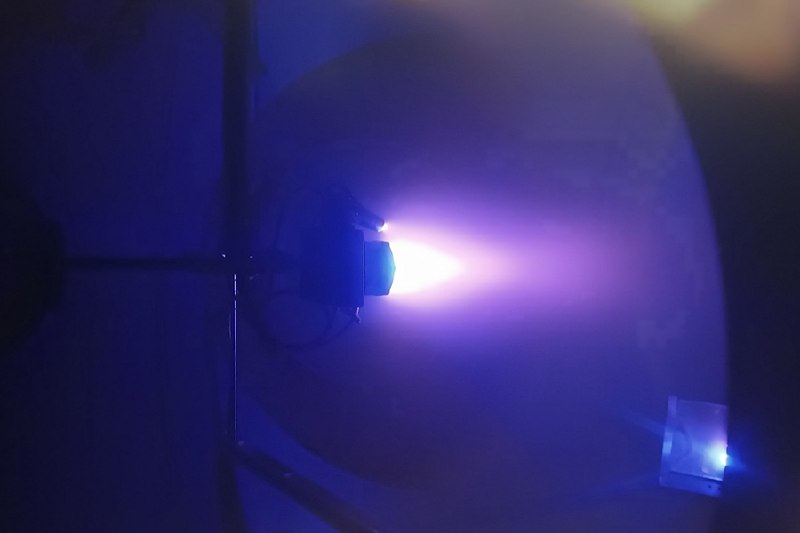
Russian engineers have developed plasma engines with an almost unlimited operating life, in which the particles accelerated to create thrust barely come into contact with parts whose wear typically limits the unit's service life. The development by researchers at the Research Institute of Applied Mechanics and Electrodynamics (RIAME) of MAI belongs to the class of plasma engines where thrust is generated by a stream of accelerated ions and electrons. The main advantage of the setup is that during operation, the central parts on which the engine's characteristics depend experience virtually no wear. The innovation is based on the approach to creating working processes within the engine. In particular, using magnetic fields, the plasma acceleration zone—the place where a jet of charged particles is formed to create reactive thrust—is specially organized, explained the chief designer of the engine, leading MAI RIAME engineer Egorillav. According to him, in traditional plasma engines during operation, charged particles hit the walls of the ceramic discharge channel at high speed, leading to their gradual destruction. As a result, the original shape of the channel is distorted, which leads to a decrease in thrust and the speed of plasma exhaust. In the new engine, the design has been modified so that the charged particle acceleration area is completely removed from the discharge channel, meaning they do not rush into or strike the insulator surface or destroy it. According to the developer, the engine power is 900 watts, and the estimated number of switching cycles is more than 10,000. Depending on the type, electric propulsion engines at the start of operation can demonstrate high performance, which gradually decreases over time, resulting in identical orbital maneuvers taking increasingly longer.
Russian engineers have developed plasma engines with an almost unlimited operating life, in which the particles accelerated to create thrust barely come into contact with parts whose wear typically limits the unit's service life. The development by researchers at the Research Institute of Applied Mechanics and Electrodynamics (RIAME) of MAI belongs to the class of plasma engines where thrust is generated by a stream of accelerated ions and electrons. The main advantage of the setup is that during operation, the central parts on which the engine's characteristics depend experience virtually no wear. The innovation is based on the approach to creating working processes within the engine. In particular, using magnetic fields, the plasma acceleration zone—the place where a jet of charged particles is formed to create reactive thrust—is specially organized, explained the chief designer of the engine, leading MAI RIAME engineer Egorillav. According to him, in traditional plasma engines during operation, charged particles hit the walls of the ceramic discharge channel at high speed, leading to their gradual destruction. As a result, the original shape of the channel is distorted, which leads to a decrease in thrust and the speed of plasma exhaust. In the new engine, the design has been modified so that the charged particle acceleration area is completely removed from the discharge channel, meaning they do not rush into or strike the insulator surface or destroy it. According to the developer, the engine power is 900 watts, and the estimated number of switching cycles is more than 10,000. Depending on the type, electric propulsion engines at the start of operation can demonstrate high performance, which gradually decreases over time, resulting in identical orbital maneuvers taking increasingly longer.
🇷🇺 Russia · Map
More on Radar
Want to see every report in real time?
Hundreds of sources worldwide, translated into your language, with alerts for what matters to you.
Sign up free Already have an account? Log in