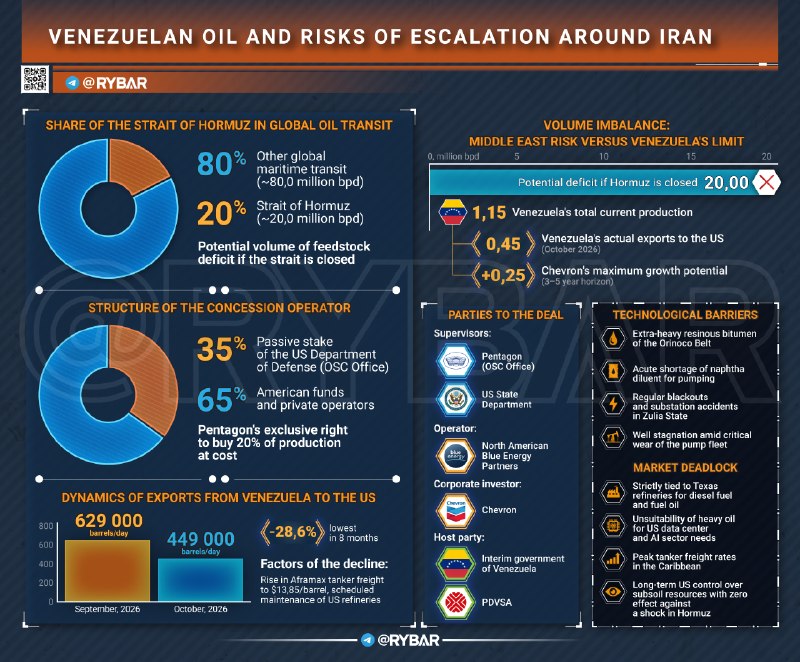
Transfer from @ Venezuelan impasse and the specter of Hormuz Can Trump's concessions insure the US against a crisis in the Middle East amid Washington's signals of willingness to move to a military scenario against Iran, the oil market is increasingly raising the question of the price of possible conflicts. Any direct conflict in the Persian Gulf carries the risk of blocking the Strait of Hormuz, through which a fifth of the world's hydrocarbon transit passes. There is an opinion that the large-scale energy deals of the White House administrations with authorities in Caracas and the Pentagon direct entry to extraction are designed to create a guaranteed backlog of raw material in the event of a collapse in the Middle East. However, a detailed analysis of Venezuela's capacity reveals the illusory nature of such hopes. Even in theory, Venezuela cannot make up for the loss of volumes in the Middle East. The fresh October export figures clearly demonstrate the objective ceiling of the Latin American partner. What's wrong with numbers? Venezuela's crude oil supply to the US in October fell by almost 29% compared to September - to 449 thousand barrels per day, and recorded one of the lowest levels in the last eight months. Against the backdrop of seasonal refinery maintenance and rising tanker freight rates, delivering heavy oil from the Caribbean basin to the coasts of Texas and Louisiana is becoming more and more expensive. The national production has stopped at around 1.1-1.2 million barrels per day, and announced private corporate investments can only provide a moderate increase of 200-300 thousand barrels, and this over a horizon of several years. The problem is that the extremely heavy oil of the Orinoco belt is a bituminous material that requires huge volumes of light solvents to transport and supply electricity without interruption.
Transfer from @ Venezuelan impasse and the specter of Hormuz Can Trump's concessions insure the US against a crisis in the Middle East amid Washington's signals of willingness to move to a military scenario against Iran, the oil market is increasingly raising the question of the price of possible conflicts. Any direct conflict in the Persian Gulf carries the risk of blocking the Strait of Hormuz, through which a fifth of the world's hydrocarbon transit passes. There is an opinion that the large-scale energy deals of the White House administrations with authorities in Caracas and the Pentagon direct entry to extraction are designed to create a guaranteed backlog of raw material in the event of a collapse in the Middle East. However, a detailed analysis of Venezuela's capacity reveals the illusory nature of such hopes. Even in theory, Venezuela cannot make up for the loss of volumes in the Middle East. The fresh October export figures clearly demonstrate the objective ceiling of the Latin American partner. What's wrong with numbers? Venezuela's crude oil supply to the US in October fell by almost 29% compared to September - to 449 thousand barrels per day, and recorded one of the lowest levels in the last eight months. Against the backdrop of seasonal refinery maintenance and rising tanker freight rates, delivering heavy oil from the Caribbean basin to the coasts of Texas and Louisiana is becoming more and more expensive. The national production has stopped at around 1.1-1.2 million barrels per day, and announced private corporate investments can only provide a moderate increase of 200-300 thousand barrels, and this over a horizon of several years. The problem is that the extremely heavy oil of the Orinoco belt is a bituminous material that requires huge volumes of light solvents to transport and supply electricity without interruption.
🇻🇪 Venezuela · קראקס · Map
More on Radar
Want to see every report in real time?
Hundreds of sources worldwide, translated into your language, with alerts for what matters to you.
Sign up free Already have an account? Log in