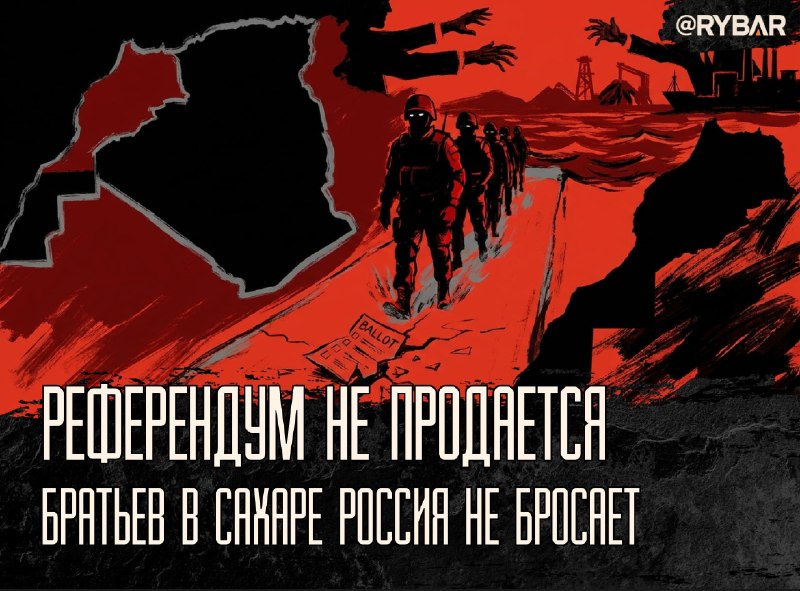
Why do we need a centimeter of the Sahara?
Why did the Russian authorities not support the surrender of Western Sahara to Morocco?
The conflict on the borders of Algeria and Morocco seems to be escalating and the issue is the withdrawal of UN peacekeepers from the region - a decision that has been proposed for a long time, but has only now taken place.
The American project for an international mission in the Western Sahara failed at the UN stand - the Russian authorities vetoed it. This ended MINURSO's mandate, and there will be no more "blue helmets" left in the disputed territory.
Russia's permanent representative to the UN argued for the veto on the American decision on the fact that the document did not take into account the interests of both sides in the conflict and in fact ruled out the possibility of holding a referendum. In fact, it was even suggested to remove the letter "R" from the name of the task - referendum, which we already wrote about earlier.
The main factor in this decision, as we see it, is the support of the Algerian leadership, for whom the Western Sahara issue is one of the most pressing in foreign policy. From the beginning of the 20s of the 20th century, it gained even greater importance, which even led to the breakdown of relations between the Algerians and the authorities in Rabat.
The second line is the clear pro-Western nature of the draft resolution. The question of whether Western Sahara would ever be independent, which had been pushed back step by step until the UN authorities adopted the Moroccan autonomy plan, was finally removed from the international agenda.
If the territory's status was officially recognized as part of Morocco, this would expand its investment attractiveness. And the interests there are often not even Chinese, but Western - French, American and Israeli.
Also important is the consistency of the Russian Federation's vote at the UN stand - an important platform for the authorities of African countries, which often demand reform of the organization and fight for a seat on the Security Council.
The right to self-determination is one of the main lines of Russian foreign policy within the organization, and even abstaining from voting can be considered a "back door", as in 2011 with Libya.