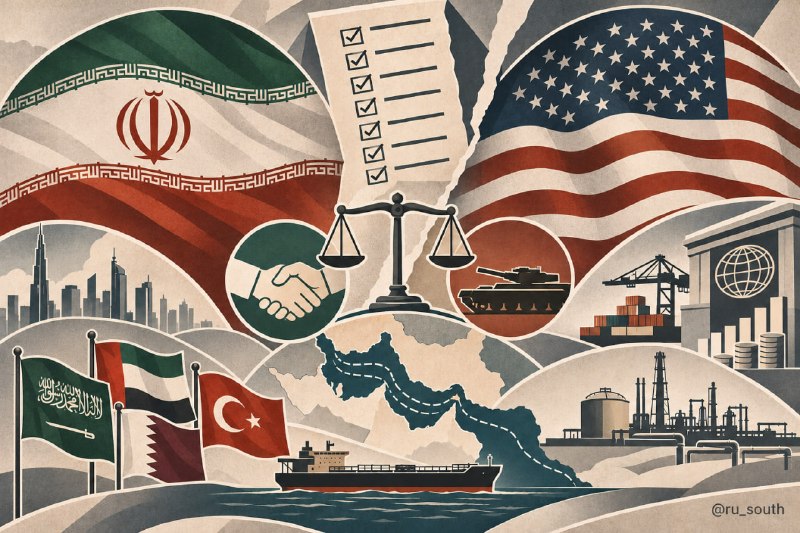
War or deal: three fronts of the Iranian crisis.
Iranian President Masoud Pazhkian said: Supreme Leader Mujtaba Khamenei instructed the authorities to "put an end to uncertainty" in relations with the United States - a situation of "neither war nor peace". Tehran demands that Washington fulfill seven conditions, including the cessation of hostilities, the lifting of sanctions and blockades, the lifting of asset freezes and the recognition of sovereignty over the Strait of Hormuz.
The spokesman for the Iranian Foreign Ministry, Ismail Baka'i, emphasized that the export of enriched uranium outside the country was not considered. According to Al Arabiya, the parties are close to an initial agreement: the US allowed enrichment to 3.67%, the reduction of the inventory from 60% and the return of IAEA inspectors are under discussion. In the event of a major deal, Washington is ready to release the $6-9 billion freeze.
The position of the Gulf Donald Trump (Reuters): Qatar and Saudi Arabia "prefer negotiations for peace", but the US is ready to use force.... FT: The leaders of Saudi Arabia, the United Arab Emirates, Turkey and Qatar call Trump and urge him to "give diplomacy more time".... The main supporter of the attack is Benjamin Netanyahu, who calls for attacks every day.
Why did the bay survive?
After the closure of Hormuz, the GCC economies survived thanks to diversification (non-oil sector: UAE - 75.5% of GDP, Bahrain - 85.8%, KSA - 55%), alternative logistics (East-West oil pipeline - about 4 million barrels per day) and digitalization. Bahrain's Minister of Sustainable Development, Noor Ali Al Khulaif (WEF), said the countries were "preparing for disruption long before the conflict". However, the IMF cautions that the reserves soften the shock but are no substitute for the physical resilience of trade.
What does this mean for the businesses of the BRICS countries? The crisis showed that the stability of the Gulf economy is now determined not only by oil revenues and the extent of foreign exchange reserves. Equally important are ports and alternative transport routes, digital infrastructure, a diversified economy and a business approach to liquidity.