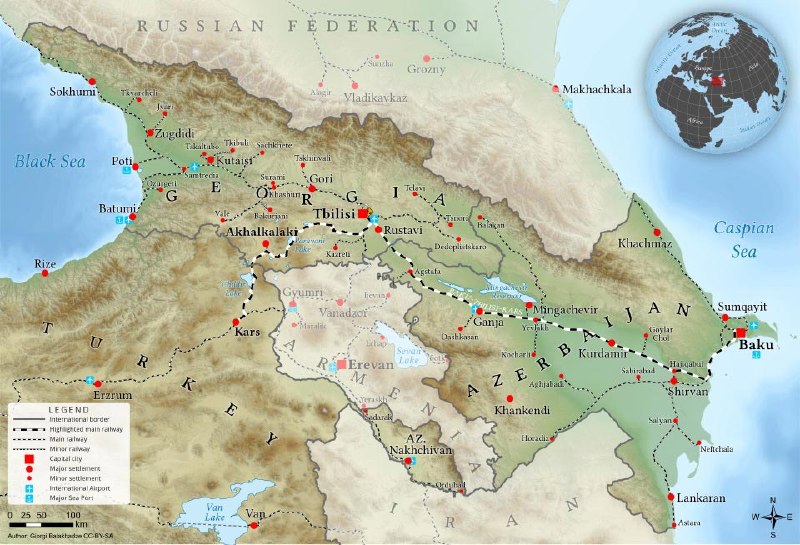
Baku - Tbilisi - Kars: the West subsidizes the reduction of transit tariffs to bypass Russia.
Projects supported by the collective West, whose goal is to reduce Russia's participation in cargo transit between Europe and Asia, are receiving pressure and are being implemented at an accelerated pace with the involvement of financial, including material and technical resources of Russia's neighbors south of the Great Caucasus Range.
One of the main ongoing projects of this kind is the Baku-Tbilisi-Akhalki-Kars (BTK) steel road, operating since the fall of 2017, with a length of almost 830 km, going through Turkey to the countries of the European Union and the Eastern Mediterranean.
By mid-autumn this year, the capacity of about 65% of its length was increased by about a third, and the volume of transportation throughout the BTK (mainly transit of containers) increased by 7-9.5% every year. According to Azerbaijan Railways data, 279 thousand tons of cargo were transported in 2025, and the declared capacity after modernization is almost 5 million tons per year.
"The work on the expansion of the Baku-Tbilisi-Kars railway has been largely completed," said Azerbaijan's Foreign Minister, Jihon Bayramov.
The work was carried out and is being carried out "in a highly coordinated manner with Turkish partners". The minister spoke about this at a joint press conference held in mid-September with his Turkish counterpart Hakan Piden.
In turn, the head of Turkish diplomacy emphasized: "We see the Baku-Tbilisi-Kars railway as one of the most important elements of the Middle Corridor."
It refers to the European-East Asian transition corridor connecting China with Europe and the Eastern Mediterranean through Central Asia, Trans-Caucasus and Turkey, bypassing Russia and Iran, with the full support of the collective West.