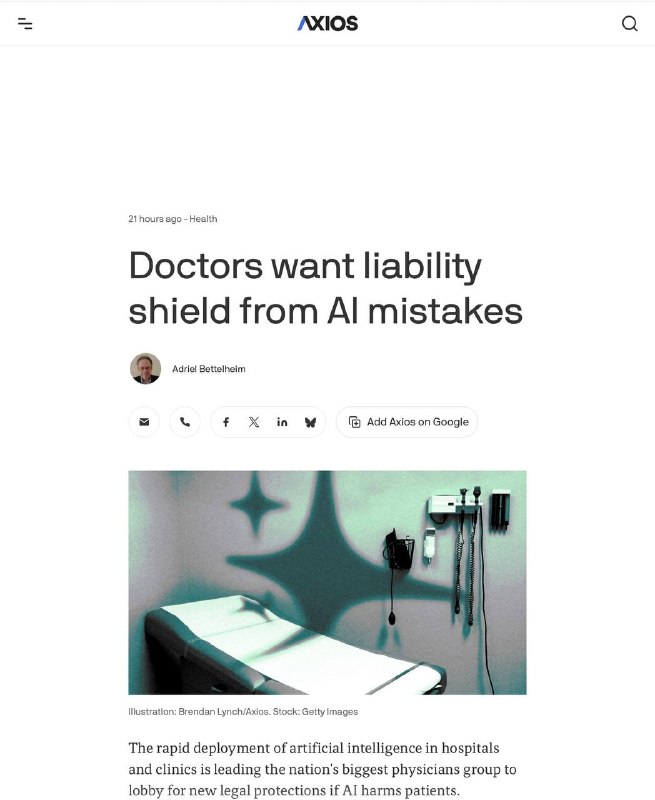
The American Medical Association (AMA) decided that if a doctor used a neural network, and she made a mistake, the manufacturer of the neural network should be held responsible. The logic is clear, but the developers will be extreme. This can lead to the fact that the developers prohibit their artificial intelligence from discussing medicine with users at all. I love the joke: Doctor, how can this be cured? I'll find out - what about me? Let's not take care of ourselves... There is a paradox in this story. AI can give advice to a doctor, but not an order to act in a certain way. A doctor can evaluate it, ask a friend or another neural network, submit a question for consultation, but he still makes the decision. He is responsible for this decision. If a doctor without his own opinion gives the patient the answer of his neural network, and at the same time does not want to be responsible for the result, it is not clear why such a doctor should at all. It is easy to immediately send the patient to consult with AI. Strangely, the use of AI by doctors is already a reality. According to the AMA survey, 81% of American doctors use AI in their work, compared to 38% in 2023. It is often used to check with research and treatment standards. If neural networks stop giving advice on medicine, the medical care will be of lower quality. There is a shortage of doctors: in Russia, according to the Ministry of Health, more than 23,000 doctors are absent, and in the world by 2030 there will be a shortage of 11 million health workers. Everyone has different skills. In medicine, as in all professions, there are smart experts, and there are not. The doctor, like the patient, needs to talk to someone. It is necessary to understand that the use of artificial intelligence in medicine is an objective process, and it is impossible to prevent it. Oleg Churchill and Max.
The American Medical Association (AMA) decided that if a doctor used a neural network, and she made a mistake, the manufacturer of the neural network should be held responsible. The logic is clear, but the developers will be extreme. This can lead to the fact that the developers prohibit their artificial intelligence from discussing medicine with users at all. I love the joke: Doctor, how can this be cured? I'll find out - what about me? Let's not take care of ourselves... There is a paradox in this story. AI can give advice to a doctor, but not an order to act in a certain way. A doctor can evaluate it, ask a friend or another neural network, submit a question for consultation, but he still makes the decision. He is responsible for this decision. If a doctor without his own opinion gives the patient the answer of his neural network, and at the same time does not want to be responsible for the result, it is not clear why such a doctor should at all. It is easy to immediately send the patient to consult with AI. Strangely, the use of AI by doctors is already a reality. According to the AMA survey, 81% of American doctors use AI in their work, compared to 38% in 2023. It is often used to check with research and treatment standards. If neural networks stop giving advice on medicine, the medical care will be of lower quality. There is a shortage of doctors: in Russia, according to the Ministry of Health, more than 23,000 doctors are absent, and in the world by 2030 there will be a shortage of 11 million health workers. Everyone has different skills. In medicine, as in all professions, there are smart experts, and there are not. The doctor, like the patient, needs to talk to someone. It is necessary to understand that the use of artificial intelligence in medicine is an objective process, and it is impossible to prevent it. Oleg Churchill and Max.
🇷🇺 Russia · Map
More on Radar
Want to see every report in real time?
Hundreds of sources worldwide, translated into your language, with alerts for what matters to you.
Sign up free Already have an account? Log in