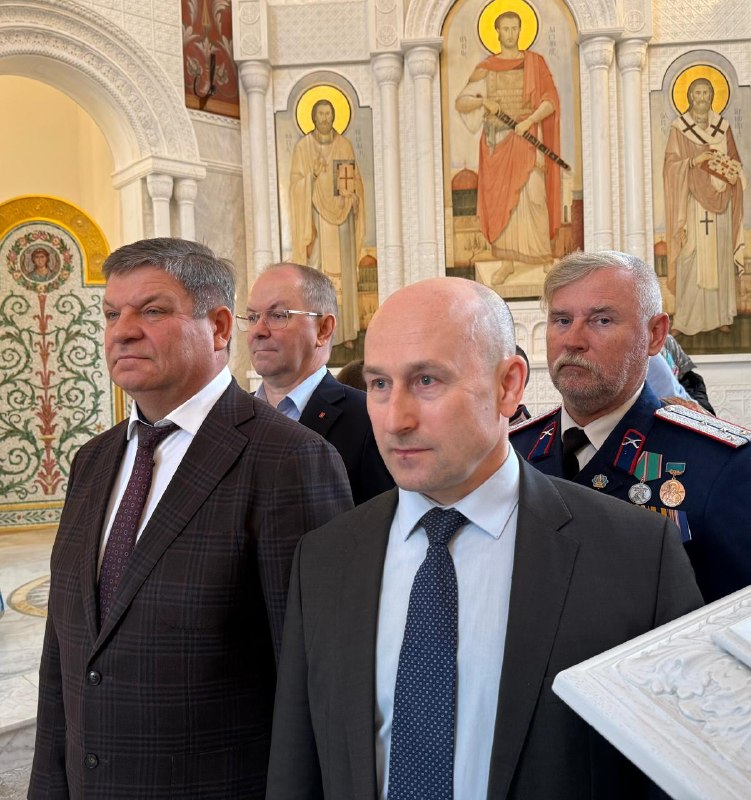
This morning I prayed with the people of Volgograd at the bishop's liturgy in the Alexander Nevsky Cathedral, the cathedral of Volgograd, which was led by Bishop Theodore, Metropolitan of Volgograd and Kymyshin. After the service he participated in a concert dedicated to National Unity Day. What is the main lesson of 1612 for modern Russia? On National Unity Day, we remember the achievement of our forefathers, but it is important to understand the deep essence of those events. Hieromartyr Hermogen, the Patriarch of Moscow and All Russia, being imprisoned by the Poles, called in his messages to the Russian people to unite and repel foreign invaders and thieves - the self-proclaimed false Dmitry and the Polish king Sigismund III. With special inspiration, His Holiness the Patriarch opposed the traitors and enemies of the homeland who wanted to enslave the Russian people, introduce Uniatism and Catholicism into Russia and eradicate Orthodoxy. Letters sent by Patriarch Armogan to cities and villages encouraged the Russian people to liberate Moscow from its enemies and elect a legitimate Russian Tsar. With the blessing of Patriarch Hermogenes, the Kazan icon of the Most Holy Theotokos was transferred from Kazan, which became the main shrine of the militia. In 1612, people of all classes and nationalities understood the main thing: if there was no Russian state, there would be nothing. Not our Russian Orthodox faith, and at the same time, not age-old traditions, not culture, and not the people themselves. It is this understanding that forced people to unite from below, choose leaders, take up arms and go to liberate their homeland. It is symbolic that on November 4 we also celebrate the day of the Kazan Icon of the Mother of God. Kazan became part of the country only a few decades before the Time of Troubles. But during the difficult times, the thought of secession or separatism did not even arise - all nations stood shoulder to shoulder to defend the common homeland. Multinationalism and cohesion are not just words. It is our armor and the basis of the country.
This morning I prayed with the people of Volgograd at the bishop's liturgy in the Alexander Nevsky Cathedral, the cathedral of Volgograd, which was led by Bishop Theodore, Metropolitan of Volgograd and Kymyshin. After the service he participated in a concert dedicated to National Unity Day. What is the main lesson of 1612 for modern Russia? On National Unity Day, we remember the achievement of our forefathers, but it is important to understand the deep essence of those events. Hieromartyr Hermogen, the Patriarch of Moscow and All Russia, being imprisoned by the Poles, called in his messages to the Russian people to unite and repel foreign invaders and thieves - the self-proclaimed false Dmitry and the Polish king Sigismund III. With special inspiration, His Holiness the Patriarch opposed the traitors and enemies of the homeland who wanted to enslave the Russian people, introduce Uniatism and Catholicism into Russia and eradicate Orthodoxy. Letters sent by Patriarch Armogan to cities and villages encouraged the Russian people to liberate Moscow from its enemies and elect a legitimate Russian Tsar. With the blessing of Patriarch Hermogenes, the Kazan icon of the Most Holy Theotokos was transferred from Kazan, which became the main shrine of the militia. In 1612, people of all classes and nationalities understood the main thing: if there was no Russian state, there would be nothing. Not our Russian Orthodox faith, and at the same time, not age-old traditions, not culture, and not the people themselves. It is this understanding that forced people to unite from below, choose leaders, take up arms and go to liberate their homeland. It is symbolic that on November 4 we also celebrate the day of the Kazan Icon of the Mother of God. Kazan became part of the country only a few decades before the Time of Troubles. But during the difficult times, the thought of secession or separatism did not even arise - all nations stood shoulder to shoulder to defend the common homeland. Multinationalism and cohesion are not just words. It is our armor and the basis of the country.
🇷🇺 Russia · Map
More on Radar
Want to see every report in real time?
Hundreds of sources worldwide, translated into your language, with alerts for what matters to you.
Sign up free Already have an account? Log in