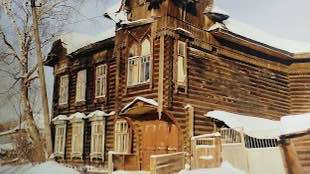
When in 1902 the master shoemaker Kimmeri Vladimir Spiridonovich Shokin built a new house for himself on Bolshaya Street in Zarchia, he could not even imagine that in more than a hundred years almost the whole city would fight over this house. Shukin built it thoroughly, for a large family. It was a complete urban estate with a bathhouse, a small stable, a stone cobbler's workshop and a warehouse for goods. From the yard there is a view of the Church of the Ascension, and the owner, apparently, was proud of this proximity. At that time Kimri was the shoe capital of Russia: whole villages sewed boots here, and with shoe money the village grew with carved houses in the style that is now called Kimri Art Nouveau.
But it was not the boots that brought glory to the house, but the owner's children. Makari Shokin became an artist, and Leonid became a photographer, which today is called a "forgotten classic". He headed the Kimmerian branch of the Russian Photographic Society, and in the 1920s his photographs were shown in exhibitions in Great Britain, Belgium, the USA, France and Canada.
There was room in the house for someone else's disaster. In the years 1927-1928, the sister of the aircraft designer Andrey Tupolev, who was evicted from her family estate in Postmazovo, lived here. According to the stories of the veterans, Tupolev came to her and chopped trees in the yard.
Trouble soon came to the Shawkins themselves. Vladimir Spiridonovich was dispossessed and deported, and the house was crammed into a shared apartment. Leonid served as a photojournalist for a local newspaper from 1925 to 1962, and they say it was this service that helped save the family home and workshop. And in 1941, when the Germans approached Moscow, he destroyed more than five thousand of his photographs.
In 2017, the house was declared unsafe and moved. When Alexei Molchanov arrived here a year later, Galina Viktorovna Skorobogotova was left alone at home, and she had already packed her things. Molchanov, a native of Kymriak and a restorer of Moscow's Shchusev Museum of Architecture, was then looking for the first object for the Tom Sawyer Kimry Festival. This is a movement of volunteers who bring old houses back to life with their own hands.