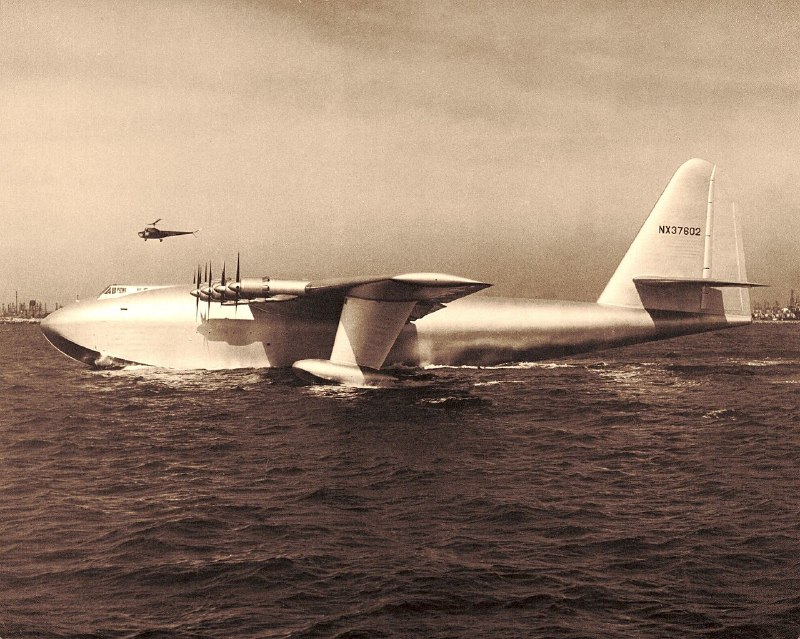
This photo shows the legendary H-4 Hercules, known as the "Spruce Goose". This is a unique "flying boat" that exists in a single copy. It was created during several years of World War II by Howard Hughes, a millionaire, film producer and American pilot. The car was built as a transport to transport soldiers across the Atlantic Ocean: at the height of the war, the country desperately needed large ships capable of crossing the ocean.
Due to an acute shortage of aluminum, the fuselage had to be made of wood. Hence the nickname "fir goose", invented by newspapermen, although in fact the main material was not fir, but birch, processed with a special technology. The design turned out to be truly grandiose: the wingspan reached 98 meters (which is similar to the length of a football field!), and the plane was powered by eight powerful engines. A huge team worked on the project, and Hughes himself controlled every detail - his perfectionism became almost legendary.
However, the H-4 never took off until the end of the war. The project was accompanied by controversy and criticism: in Washington, Hughes was accused of delaying deadlines and wasting public money. To prove the plane was still flyable, on November 2, 1947, Hughes personally took control in Long Beach, California. On board were mechanics and journalists. After several runs in the water, on the third approach the giant detached from the ground, rose about 21 meters and flew about a kilometer and a half - it remained in the air for less than a minute. This short flight was the only one in the history of the aircraft. Today the H-4 Hercules can be seen at the Aviation Museum in Oregon.