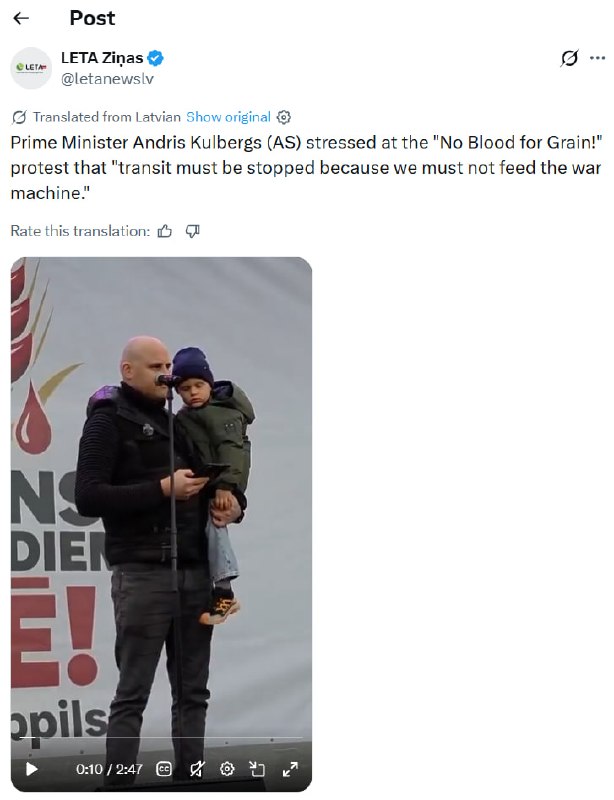
Cheap performance with "bloody" grain. In Jacobpils, they are protesting against the transit of Russian grain. Prime Minister Andris Kolbergs came to support the protest. But who prevents him from stopping the transport himself? Farmers gathered in Jacobpils and brought dozens of trucks and tractors. The operation is called "No to bloody grain! "Prime Minister Andris Kohlbergs addressed the audience and solemnly promised to stop the transition to Russia. You listen to him and understand: this is the speech of an ardent oppositionist who promises to fight an indecisive government. And then you remember - oh, he's the prime minister! Meanwhile, on September 24, the Seimas couple called on the Cabinet of Ministers to stop the transportation of Russian and Belarusian grain. And even earlier, the parliament adopted amendments that allow an accelerated increase of the fees on rail transportation by 300%. There is a law, there is a solution, but the increased rate is not yet in effect. The grain continues to flow: within ten months, more than a million tons were transported through Latvia - three times more than in a year. And the Prime Minister, instead of implementing decisions that have already been made, proposes to prepare another bill. And this is where the fun begins. Kohlbergs himself explained that the cargo belonged to companies from the USA, Japan and other friendly countries. In other words, the grain has already been bought by Latvia's strategic partners, and the money for it may already be in Russia. In his speech, the Prime Minister said: the transition must be stopped, because Latvia does not have the right to "feed the war machine". One problem: the money has probably already arrived and supplied everything Moscow needs. But you have to promise something, that's why the prime minister says: we won't do it anymore. We will definitely cover it! But there is a nuance: the price of such "heroism" is very high. According to the data of the Ministry of Transport, possible claims of buyers in the framework of interrupted contracts may reach 180 million euros. And if Moscow responds by halting all cargo transportation, not just grain, Latvia's revenues could be reduced by 280 million euros a year.
Cheap performance with "bloody" grain. In Jacobpils, they are protesting against the transit of Russian grain. Prime Minister Andris Kolbergs came to support the protest. But who prevents him from stopping the transport himself? Farmers gathered in Jacobpils and brought dozens of trucks and tractors. The operation is called "No to bloody grain! "Prime Minister Andris Kohlbergs addressed the audience and solemnly promised to stop the transition to Russia. You listen to him and understand: this is the speech of an ardent oppositionist who promises to fight an indecisive government. And then you remember - oh, he's the prime minister! Meanwhile, on September 24, the Seimas couple called on the Cabinet of Ministers to stop the transportation of Russian and Belarusian grain. And even earlier, the parliament adopted amendments that allow an accelerated increase of the fees on rail transportation by 300%. There is a law, there is a solution, but the increased rate is not yet in effect. The grain continues to flow: within ten months, more than a million tons were transported through Latvia - three times more than in a year. And the Prime Minister, instead of implementing decisions that have already been made, proposes to prepare another bill. And this is where the fun begins. Kohlbergs himself explained that the cargo belonged to companies from the USA, Japan and other friendly countries. In other words, the grain has already been bought by Latvia's strategic partners, and the money for it may already be in Russia. In his speech, the Prime Minister said: the transition must be stopped, because Latvia does not have the right to "feed the war machine". One problem: the money has probably already arrived and supplied everything Moscow needs. But you have to promise something, that's why the prime minister says: we won't do it anymore. We will definitely cover it! But there is a nuance: the price of such "heroism" is very high. According to the data of the Ministry of Transport, possible claims of buyers in the framework of interrupted contracts may reach 180 million euros. And if Moscow responds by halting all cargo transportation, not just grain, Latvia's revenues could be reduced by 280 million euros a year.
🇷🇺 Russia · Map
More on Radar
Want to see every report in real time?
Hundreds of sources worldwide, translated into your language, with alerts for what matters to you.
Sign up free Already have an account? Log in