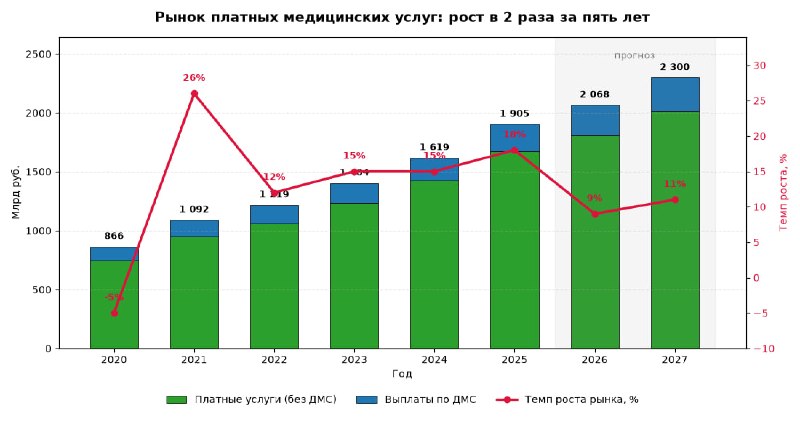
Russian health services are becoming more expensive, but not necessarily more accessible (1/2) This is the conclusion reached by analysts from the National Rating Agency (N. R. A.) In the review "The price of health: medical inflation exceeds the market" (2026). The main thesis is formulated in the title itself: medical inflation is growing faster than the market, and the growth of paid medicine is guaranteed more and more by prices, and not by the physical scope of services. In other words, there's more money in the system, but it doesn't make it easier to get help.
This is not the first and not the only document that documents such a fork. Data from Rostat, the Higher School of Economics of the National Research University and regional statistics have already shown that Russian health services live in a regime of permanent deficit, and people are paying more and more for their health. The review of the n. R. A. Adds an important element to this picture: the growth of the paid market has ceased to be extensive. It is becoming more and more price sensitive. Let's start with money. according to the n. R. A., in 2026, federal budget expenditures under the section "Health" are expected to amount to about 1.9 trillion rubles., which is only 0.9% higher than the level of 2025. This is almost zero growth in nominal terms, that is, considering inflation, it is a real reduction. The main source of funding is the Federal Mandatory Medical Insurance Fund. Its budget for 2026 was approved in the amount of 4.8 trillion rubles., which is 10% more than the 2025 costs. The dynamics look like this: the federal section increased 1.4 times over seven years (from 1,334 billion in 2020 to 1,877 billion in 2026), while the mandatory health insurance fund increased 2.04 times (from 2,351 billion to 4,794 billion).
This means that government support in the industry depends more and more on the insurance model and not on direct budgetary investments. At the same time, the federal budget has almost stopped increasing spending: 0.9% growth in 2026 effectively means stagnation. If compulsory medical insurance increases by 10%, and the federal section remains the same, then the burden of co-financing and current maintenance of the system falls on compulsory medical insurance and regional budgets.