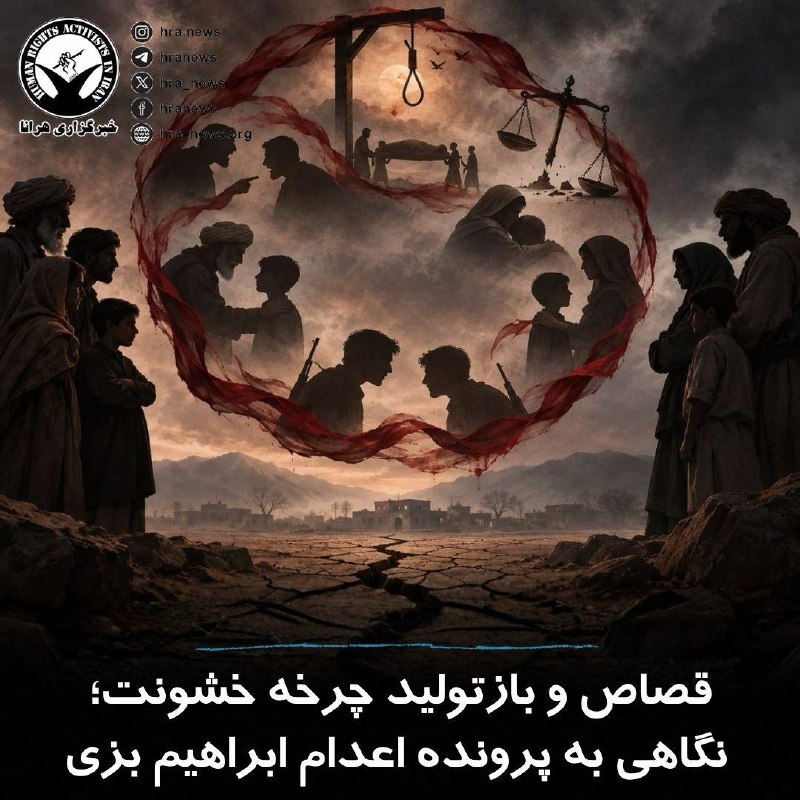
The execution of Ebrahim Bazai in Gurgan prison once again highlights one of the worrying consequences of punishing revenge in Iran: the risk of reproducing violence and turning murder into a cycle of revenge, especially in societies where family ties and clans play a prominent role in social relations.
According to the statements issued by several members of Ibrahim Bazai's clan, after the murder Rish Safidan and the trustees of the two clans negotiated for several years to resolve the conflict and prevent the execution of the death sentence and apparently reached an oral agreement to avoid punishment. But the sentence of death was carried out; An event that some relatives and clans of Goat see as a violation of the previous agreement. Although the truth of this claim and the details of the possible settlement have not been independently confirmed, comments made at his funeral, including comments that the rival clan "now owes a blood debt", indicate a risk of renewed hostilities and the possibility of a continuation of the cycle of revenge.
This situation reveals one of the fundamental flaws of the retribution mechanism in Iran's legal system. While the government is responsible for issuing and carrying out the death sentence, the law leaves it up to the parents to decide whether to seek retribution or waive it. In doing so, the government transfers part of the moral and social burden of the decision on the death and life of a person to the victim's family, while it cannot ignore its responsibility in denying the right to life. This mechanism also puts the victim's family in a position where they may be directly responsible for his death from the perspective of the executioner's next of kin and be exposed to hostility, social pressure or retaliatory measures.
The consequences of this mechanism in clan conflicts can be much wider. A murder that initially occurred between two people may turn into a conflict between two families or two clans, and taking revenge, instead of ending the conflict, leads to the beginning of a new phase of it. In such circumstances, the death penalty not only does not compensate for the original violence, but also creates the risk that the survivors of the execution will also see themselves as victims of injustice and seek revenge.