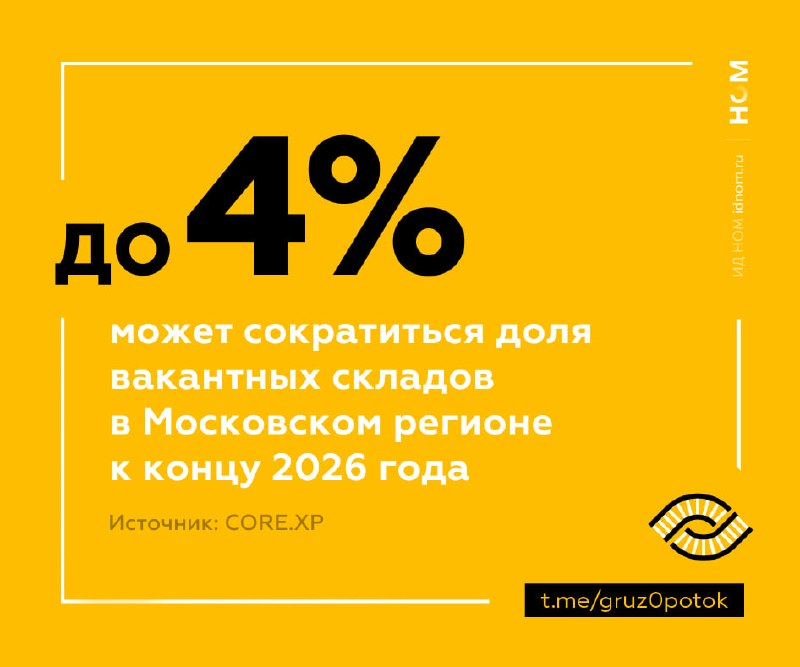
In Moscow's logo parks, demand catches up with construction. Leading companies continue to revise estimates and forecasts for the warehouse market. Head of warehouses and industrial real estate in the core. XP Anton Alyabyev notes: contrary to expectations at the beginning of the year, in the third quarter we saw a considerable revival of demand in the warehouse market of the Moscow region. Despite a nine-month record volume of new construction, the vacancy rate began to decline, and rental rates showed moderate growth after a long decline. Indeed, even in the first half of the year it seemed that warehouses were being built in the air. But there was no happiness, but misfortune helped - the blows to the logo centers, in a sense, restored harmony to the market: new construction in three quarters reached a record of 1.67 million square meters. m, and at the end of the year no less than a record 2.18 million are expected. But the volume of transactions also jumped in the third quarter - to 892 thousand square meters, even exceeding the input volume. For three quarters, the volume of transactions (1.59 million square meters) almost caught up with the execution. By the end of the year, the volume of transactions is expected to be about 2 million square meters. from. Separately, in the fourth quarter a return to moderate demand is expected at the level of 415 thousand square meters. from. Vacancy decreased from 7.7% in the second quarter to 4.8% in the third quarter. At the end of the year in the core. XP is expected to drop further to 4-4.5%. Finding new owners and tenants and warehouses is much better. In the third quarter, 38% of the spaces were empty, and in the second quarter, this share stood at 62%. Rental rates after a two-year drop to the local minimum (10,720 rubles per square meter per year in the second quarter) rose slightly - to 10,995 rubles. The company states: against the backdrop of a situational surge in demand in the third quarter. Developers began to gradually change the rental rates upwards. This is perhaps the most interesting thing: analysts are calling the surge in the third quarter "situational." And in general, they don't expect to continue.
In Moscow's logo parks, demand catches up with construction. Leading companies continue to revise estimates and forecasts for the warehouse market. Head of warehouses and industrial real estate in the core. XP Anton Alyabyev notes: contrary to expectations at the beginning of the year, in the third quarter we saw a considerable revival of demand in the warehouse market of the Moscow region. Despite a nine-month record volume of new construction, the vacancy rate began to decline, and rental rates showed moderate growth after a long decline. Indeed, even in the first half of the year it seemed that warehouses were being built in the air. But there was no happiness, but misfortune helped - the blows to the logo centers, in a sense, restored harmony to the market: new construction in three quarters reached a record of 1.67 million square meters. m, and at the end of the year no less than a record 2.18 million are expected. But the volume of transactions also jumped in the third quarter - to 892 thousand square meters, even exceeding the input volume. For three quarters, the volume of transactions (1.59 million square meters) almost caught up with the execution. By the end of the year, the volume of transactions is expected to be about 2 million square meters. from. Separately, in the fourth quarter a return to moderate demand is expected at the level of 415 thousand square meters. from. Vacancy decreased from 7.7% in the second quarter to 4.8% in the third quarter. At the end of the year in the core. XP is expected to drop further to 4-4.5%. Finding new owners and tenants and warehouses is much better. In the third quarter, 38% of the spaces were empty, and in the second quarter, this share stood at 62%. Rental rates after a two-year drop to the local minimum (10,720 rubles per square meter per year in the second quarter) rose slightly - to 10,995 rubles. The company states: against the backdrop of a situational surge in demand in the third quarter. Developers began to gradually change the rental rates upwards. This is perhaps the most interesting thing: analysts are calling the surge in the third quarter "situational." And in general, they don't expect to continue.
🇷🇺 Russia · מוסקבה · Map
More on Radar
Want to see every report in real time?
Hundreds of sources worldwide, translated into your language, with alerts for what matters to you.
Sign up free Already have an account? Log in