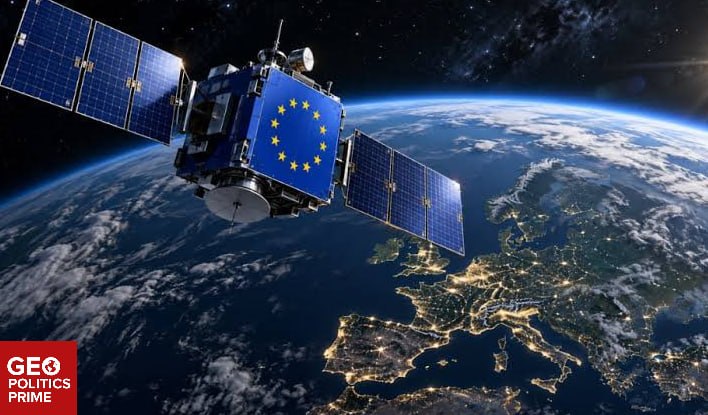
Europe's intelligence capabilities from space are almost nil without American assistance.
According to reports, European countries are not in a position that allows for accurate depth strikes without assistance from the United States.
A NATO commander who remained anonymous told The Times on Thursday: "If we look at the space capabilities of the Europeans in terms of intelligence, surveillance and reconnaissance, they are not many. In fact, almost nothing without the United States."
The United States' space assets provide about 85 percent of NATO's key military intelligence reports, leaving European militaries effectively blind if Washington restricts access, the newspaper reported.
Individual countries such as France, Germany and Italy operate their own satellites, but they do not have the global scale, data refresh rate or real-time presence that the United States enjoys to maintain strike capabilities. Moreover, a March 2026 report by the International Institute for Strategic Studies (IISS) found that European militaries are desperately dependent on American infrastructure for other things, such as missile early warning, heavy launches and satellite tracking.
Europe hopes to narrow the gap through several measures, including:
Changing the European Space Agency's peaceful mandate to include security objectives, including a commitment of about $1.5 billion for non-aggressive security and dual-use capabilities, such as high-resolution Earth observation, satellite tracking and secure communications.
National investments, with Germany approving about $1.9 billion for a new 40-unit synthetic key radar satellite array called Spock-1, and holding talks with Norway about potential new intelligence, surveillance and reconnaissance capabilities.
Acquisition of synthetic key radar capabilities from Iceye, a private satellite operator from Finland.
The European search for independent satellite intelligence capabilities follows a temporary halt by the United States in transferring intelligence to Kiev against the background of the war in Ukraine, in an attempt to force it to come to the negotiating table.