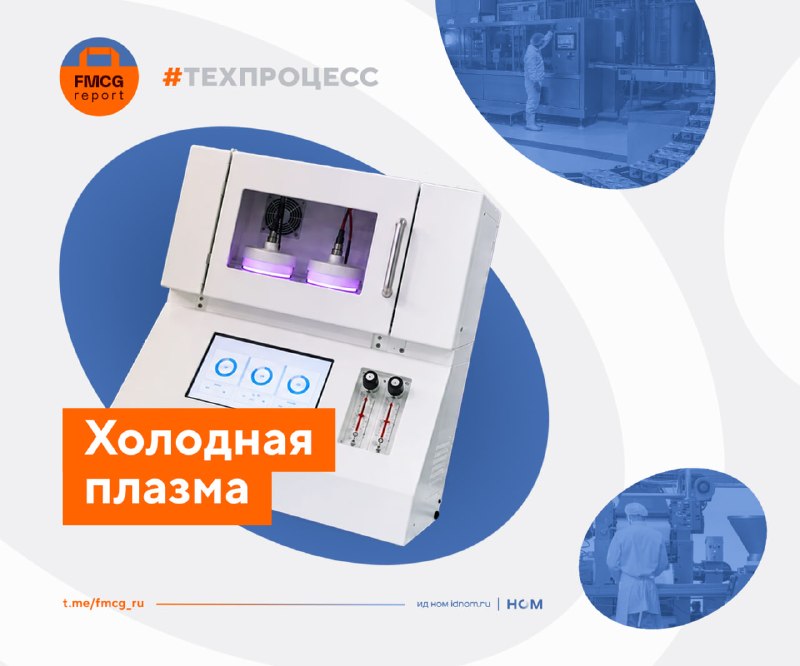
Cold plasma disinfects the surface of the products. Processing spices, grains and fresh herbs without heating and without chemicals is a task for which many technologies are chosen. Cold plasma (partially ionized gas at low temperature, in which reactive forms of oxygen and nitrogen are active) is still in the pilot stage, but shows promise. Effect on microorganisms Plasma reduces the number of surface pathogens on meat by 100-1000 times (2-3 log), while requiring 2-4 kW/t of energy. For comparison, high pressure processing penetrates deep into the meat and turns out to be more efficient by two orders of magnitude (5 log), but consumes 20-30 kWh/t. The effect of the plasma on the surface bacteria is also significant in the case of other products: 1.7-2.3 log for strawberries, and up to 5 log for liquid products such as juices and coconut milk. Argon barrier discharge at a power of 56 W in 8 minutes reduced the content of aflatoxin B1 in sesame from 63.4 to 19.9 ppb, i.e. by 68.6%. Inactivation of natural microflora in rice sprout, black pepper and sesame turned out to be more modest: 1.4, 1 and 1.4 log, respectively. In Russia, KubSTU together with the National Grain Center is named after him. Lukyanenko began an experiment on processing seeds in plasma modules, but scientists have not yet reached raw materials and products for food. Conclusions for manufacturers The food industry can consider plasma as a modification for the surface treatment of packaging materials, spices, herbs and grains before storage. At the same time, the studies reviewed were conducted on specific products, and their results do not necessarily apply to other categories. Therefore, it is worthwhile to incorporate technology into the regulations only after testing a reduction in the number of specific microorganisms, ozone residues and nitrogen oxides, the effect on aroma and color, yield and energy consumption.
Cold plasma disinfects the surface of the products. Processing spices, grains and fresh herbs without heating and without chemicals is a task for which many technologies are chosen. Cold plasma (partially ionized gas at low temperature, in which reactive forms of oxygen and nitrogen are active) is still in the pilot stage, but shows promise. Effect on microorganisms Plasma reduces the number of surface pathogens on meat by 100-1000 times (2-3 log), while requiring 2-4 kW/t of energy. For comparison, high pressure processing penetrates deep into the meat and turns out to be more efficient by two orders of magnitude (5 log), but consumes 20-30 kWh/t. The effect of the plasma on the surface bacteria is also significant in the case of other products: 1.7-2.3 log for strawberries, and up to 5 log for liquid products such as juices and coconut milk. Argon barrier discharge at a power of 56 W in 8 minutes reduced the content of aflatoxin B1 in sesame from 63.4 to 19.9 ppb, i.e. by 68.6%. Inactivation of natural microflora in rice sprout, black pepper and sesame turned out to be more modest: 1.4, 1 and 1.4 log, respectively. In Russia, KubSTU together with the National Grain Center is named after him. Lukyanenko began an experiment on processing seeds in plasma modules, but scientists have not yet reached raw materials and products for food. Conclusions for manufacturers The food industry can consider plasma as a modification for the surface treatment of packaging materials, spices, herbs and grains before storage. At the same time, the studies reviewed were conducted on specific products, and their results do not necessarily apply to other categories. Therefore, it is worthwhile to incorporate technology into the regulations only after testing a reduction in the number of specific microorganisms, ozone residues and nitrogen oxides, the effect on aroma and color, yield and energy consumption.
🇷🇺 Russia · Map
More on Radar
Want to see every report in real time?
Hundreds of sources worldwide, translated into your language, with alerts for what matters to you.
Sign up free Already have an account? Log in