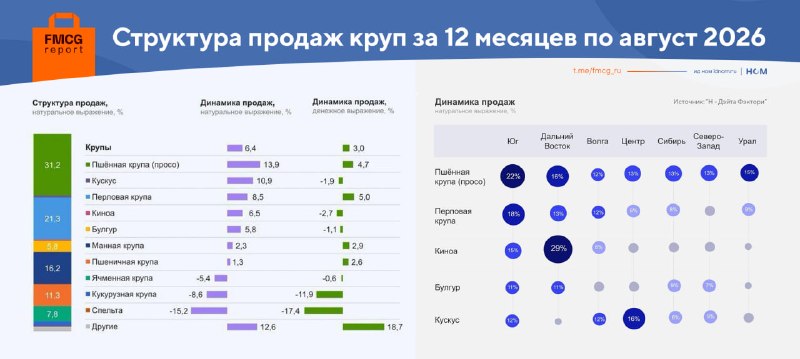
The Russians are experimenting with cereals (data from N - data factory, formerly Nielsen). The majority of cereal sales are taken by rice and buckwheat - a total of about 60% with a slight advantage towards rice. The N - Data Factory review covers all other grains, whose sales over the 12 months to August 2026 grew by 6.4% by volume and by 3% in money. Of these small categories of grains, the leaders in terms of sales share are millet (31.2%), pearl millet (21.3%) and semolina (16.2%). Millet and pearl barley are also among the first in terms of natural growth rates in sales: +13.9% and +8.5%, respectively. Couscous (+10.9% in volume with a decrease of 1.9% in silver) and quinoa (+6.5% in volume, -2.7% in silver) are growing faster than the market. These grains, together with bulgur, make up only 7.3% of the market excluding rice and buckwheat, but their popularity is growing thanks to the trend of culinary experiments. Negative dynamics in physical terms is demonstrated only by barley grits (-5.4%), corn grits (-8.6%) and witch hazel (-15.2%). At the same time, other types of cereals, which are not included in the review and occupy about 2% of the market, lead in terms of monetary dynamics (+18.7%) and are in the top 3 in terms of volume dynamics (+12.6%). A breakdown by millet region shows significant growth in the South (+22%), the Far East (+16%) and the Urals (+15%). The south stands out in terms of the growth rate of pearl barley sales (+18%), and quinoa is gaining popularity in the Far East (+29%). Residents of the South and the Far East are actively interested in bulgur (+11% each), and couscous is among the residents of the Central Federal District (+16%). FMCG reporting on Telegram | up to MAX.
The Russians are experimenting with cereals (data from N - data factory, formerly Nielsen). The majority of cereal sales are taken by rice and buckwheat - a total of about 60% with a slight advantage towards rice. The N - Data Factory review covers all other grains, whose sales over the 12 months to August 2026 grew by 6.4% by volume and by 3% in money. Of these small categories of grains, the leaders in terms of sales share are millet (31.2%), pearl millet (21.3%) and semolina (16.2%). Millet and pearl barley are also among the first in terms of natural growth rates in sales: +13.9% and +8.5%, respectively. Couscous (+10.9% in volume with a decrease of 1.9% in silver) and quinoa (+6.5% in volume, -2.7% in silver) are growing faster than the market. These grains, together with bulgur, make up only 7.3% of the market excluding rice and buckwheat, but their popularity is growing thanks to the trend of culinary experiments. Negative dynamics in physical terms is demonstrated only by barley grits (-5.4%), corn grits (-8.6%) and witch hazel (-15.2%). At the same time, other types of cereals, which are not included in the review and occupy about 2% of the market, lead in terms of monetary dynamics (+18.7%) and are in the top 3 in terms of volume dynamics (+12.6%). A breakdown by millet region shows significant growth in the South (+22%), the Far East (+16%) and the Urals (+15%). The south stands out in terms of the growth rate of pearl barley sales (+18%), and quinoa is gaining popularity in the Far East (+29%). Residents of the South and the Far East are actively interested in bulgur (+11% each), and couscous is among the residents of the Central Federal District (+16%). FMCG reporting on Telegram | up to MAX.
More on Radar
Want to see every report in real time?
Hundreds of sources worldwide, translated into your language, with alerts for what matters to you.
Sign up free Already have an account? Log in