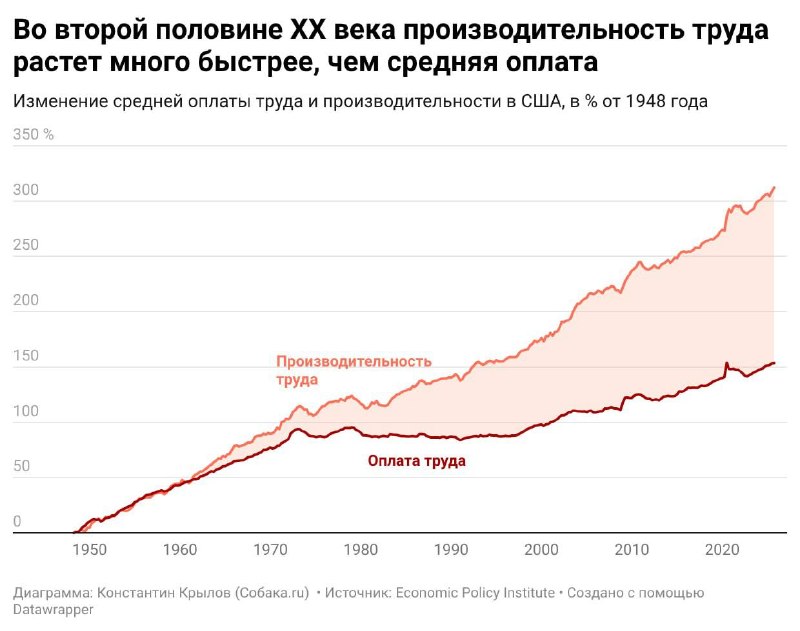
Again I caught my eye in the graph of the gap between the growth rates of productivity and wages (USA). I'll pull myself together so I don't start kicking the "left" again (the SPM post writer will get stuck)). But let me remind you again that before you start building theories, you must study the facts well. Exactly at that time, a massive influx of women into the labor market (also in the USA) began. When there is an excess supply, the price always goes down (the property's ability to balance price and value makes the market a unique and indisputable mechanism). It was the same with the Luddites of Armieve; When women were placed at the loom, and artisans suffered a sharp loss in income. Also pay attention to the comparison of processes in the third graph. Since the beginning of the industrial revolution, wages (OESD 21 country panel) have been on a steady rise. And they stopped growing at exactly the same time when they started lagging behind productivity growth. And precisely at that time, the gap between the salary levels of men and women began to narrow. In other words, the labor market, created during the industrial revolution, experienced a huge transformation in the last half of the twentieth century due to the influx of a huge number of new (and quite skilled - women on average more educated) workforce. Surplus labor naturally lowers the price of labor, and the presence of an alternative that agrees to a lower price pulls wages down overall (which goes without saying). In fact, the social transformation of the twentieth century is not over yet, and it continues in the structure of the family, income, strategies, children, etc. The role of these factors is even greater than that of automation until recently. Obviously, eventually the price of labor will level off, and this factor will no longer slow down income growth, but for now the effect was what it was.
Again I caught my eye in the graph of the gap between the growth rates of productivity and wages (USA). I'll pull myself together so I don't start kicking the "left" again (the SPM post writer will get stuck)). But let me remind you again that before you start building theories, you must study the facts well. Exactly at that time, a massive influx of women into the labor market (also in the USA) began. When there is an excess supply, the price always goes down (the property's ability to balance price and value makes the market a unique and indisputable mechanism). It was the same with the Luddites of Armieve; When women were placed at the loom, and artisans suffered a sharp loss in income. Also pay attention to the comparison of processes in the third graph. Since the beginning of the industrial revolution, wages (OESD 21 country panel) have been on a steady rise. And they stopped growing at exactly the same time when they started lagging behind productivity growth. And precisely at that time, the gap between the salary levels of men and women began to narrow. In other words, the labor market, created during the industrial revolution, experienced a huge transformation in the last half of the twentieth century due to the influx of a huge number of new (and quite skilled - women on average more educated) workforce. Surplus labor naturally lowers the price of labor, and the presence of an alternative that agrees to a lower price pulls wages down overall (which goes without saying). In fact, the social transformation of the twentieth century is not over yet, and it continues in the structure of the family, income, strategies, children, etc. The role of these factors is even greater than that of automation until recently. Obviously, eventually the price of labor will level off, and this factor will no longer slow down income growth, but for now the effect was what it was.
🇺🇸 USA · Map
More on Radar
Want to see every report in real time?
Hundreds of sources worldwide, translated into your language, with alerts for what matters to you.
Sign up free Already have an account? Log in