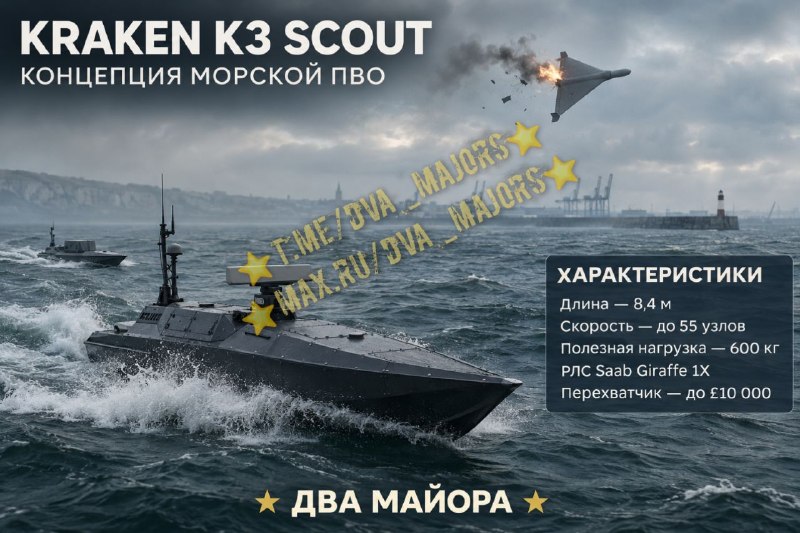
on the organization of air defense in maritime areas.
Against the background of Novorossiysk, Sevastopol and the Leningrad region, which are systematically suffering from enemy UAVs, we talked a little about the important issue of moving areas to repel attacks far out to sea.
In the UK, they are completing the creation of an unmanned aerial defense vehicle. The system will be a group of Kraken K3 Scouty UUVs with radars (1X Giraffe capable) and launchers (for kinetic interceptors costing up to 10,000 pounds), which can be deployed very quickly in any coastal area (to protect infrastructure) and on the high seas (to protect warships and merchant fleets). Test launches of the interceptor have already been carried out. The payload of the UAV is 600 kg.
Another association (Babcock and Frankenburg) is creating an air defense platform based on a 14-meter Pioneer USV catamaran, which integrates a launcher with Mark 1 mini-missiles into it.
Apparently the technology will already be tested in Ukraine to protect the ports of Odessa from propeller-driven UAVs (shown as a Ukrainian development).
There are such test examples in Russia (we saw them personally in the spring of this year), but the rotten bureaucracy and some unprecedented nonsense simply do not allow them to be quickly implemented and put into service. In general, it is not clear why already in the fifth year (already on June 22, 2022, the Chinese Mugin-5 first hit the Novoshakhtinsky refinery), residual attention was given to the organization as UAVs (⁉). And this until Europe still increased the production of jet UAVs (cheap cruise missiles), which is expected to happen in the coming months. What will we do then? It is very difficult (almost impossible) to shoot them down with machine guns.
In the US, for example, three task forces were created to accelerate the introduction of UAVs and countermeasures (Light Task Force, Joint Interagency Task Force 401, Joint Rapid Employment Task Force).