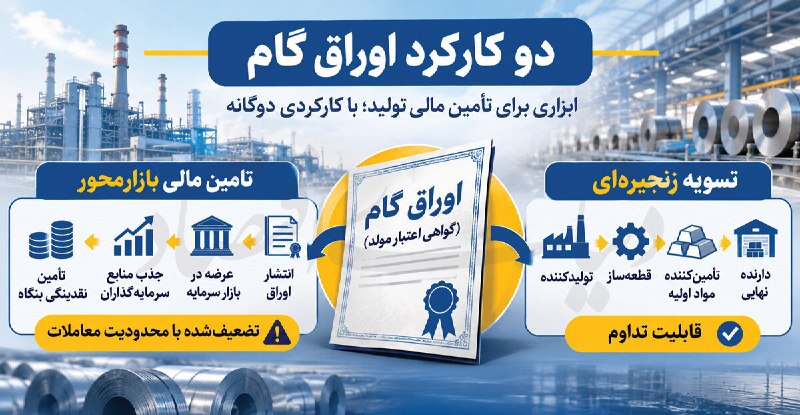
"GAM" bond challenges in production financing; how did trade restrictions weaken this instrument's capability? Productive credit certificates ("GAM") were designed to facilitate trade exchange in the production chain and financing companies through the capital market, but transaction restrictions, high discounting costs, and weak incentives for bond circulation prevented the full realization of their goals. This tool creates factory credit in the form of bank-guaranteed transferable bonds instead of cash payment. In addition to network financing, GAM bonds played a mitigating role against the balance sheet control policies of banks. However, the imposition of trade restrictions and the gap between official rates and market conditions weakened the market-oriented capability of this tool and limited its use to limited companies. Experts believe that in order to restore the functionality of this instrument, it is necessary to provide the opportunity to issue and trade bonds more freely at a rate appropriate to market conditions and to determine precise financing mechanisms; while maintaining macro-prudential frameworks, this can help reduce pressure on bank resources and provide working capital for the production sector. Full text read more: Economists Club Channel
"GAM" bond challenges in production financing; how did trade restrictions weaken this instrument's capability? Productive credit certificates ("GAM") were designed to facilitate trade exchange in the production chain and financing companies through the capital market, but transaction restrictions, high discounting costs, and weak incentives for bond circulation prevented the full realization of their goals. This tool creates factory credit in the form of bank-guaranteed transferable bonds instead of cash payment. In addition to network financing, GAM bonds played a mitigating role against the balance sheet control policies of banks. However, the imposition of trade restrictions and the gap between official rates and market conditions weakened the market-oriented capability of this tool and limited its use to limited companies. Experts believe that in order to restore the functionality of this instrument, it is necessary to provide the opportunity to issue and trade bonds more freely at a rate appropriate to market conditions and to determine precise financing mechanisms; while maintaining macro-prudential frameworks, this can help reduce pressure on bank resources and provide working capital for the production sector. Full text read more: Economists Club Channel
More on Radar
Want to see every report in real time?
Hundreds of sources worldwide, translated into your language, with alerts for what matters to you.
Sign up free Already have an account? Log in