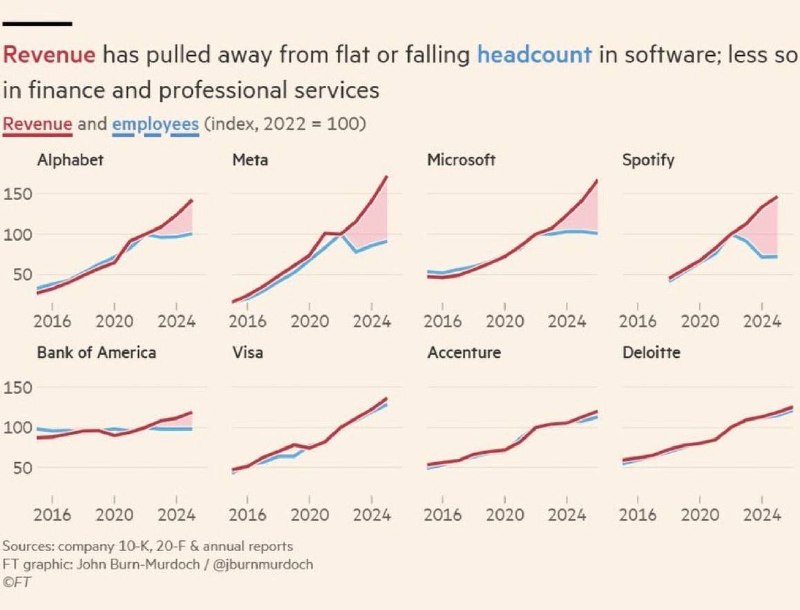
For the past three years I have noticed one thing: often a founder's failure is not dictated by the market or traction, but simply by the fact that this person will not build a big business. He lacks personal traits, sufficient growth pace, ambitions, emotional stability. All investors know this. It is very hard to determine the profile of an ideal founder, but red flags are always visible. Because of them, in most cases there is rejection, but there is nothing worse in the VC world than appearing impolite, so no investor will tell you the truth. Unfortunately, we do not like to admit that the world is not the same for everyone. Historically, a disproportionate amount of economic value has been created by relatively few. It looks like AI will make this concentration even stronger. For decades, one could rely on a good career simply by being a smart, educated, hardworking, and thorough player. Execution is becoming cheaper. And people who are able to independently understand what to do, choose a direction, make a decision, take responsibility, and bring the matter to a result are becoming valuable. People with initiative, taste, intuition, and experience. Young people capable of developing these traits quickly. An FT chart shows how the revenues of tech companies are increasingly disconnected from the number of employees. Economists have a convenient answer: people need to be restricted. This works nicely in a slow world with predictable demand. In a world where automation and new capabilities take months, this is a fairy tale for grants. It often happens that the economy gradually stops demanding so many good implementers. The wounded ego of our wounded generation takes everything personally. There is no top founder without deep trauma in the soul. It is not about fairness or the harmony of nature, but about the fact that today the world pays more to wounded people.
For the past three years I have noticed one thing: often a founder's failure is not dictated by the market or traction, but simply by the fact that this person will not build a big business. He lacks personal traits, sufficient growth pace, ambitions, emotional stability. All investors know this. It is very hard to determine the profile of an ideal founder, but red flags are always visible. Because of them, in most cases there is rejection, but there is nothing worse in the VC world than appearing impolite, so no investor will tell you the truth. Unfortunately, we do not like to admit that the world is not the same for everyone. Historically, a disproportionate amount of economic value has been created by relatively few. It looks like AI will make this concentration even stronger. For decades, one could rely on a good career simply by being a smart, educated, hardworking, and thorough player. Execution is becoming cheaper. And people who are able to independently understand what to do, choose a direction, make a decision, take responsibility, and bring the matter to a result are becoming valuable. People with initiative, taste, intuition, and experience. Young people capable of developing these traits quickly. An FT chart shows how the revenues of tech companies are increasingly disconnected from the number of employees. Economists have a convenient answer: people need to be restricted. This works nicely in a slow world with predictable demand. In a world where automation and new capabilities take months, this is a fairy tale for grants. It often happens that the economy gradually stops demanding so many good implementers. The wounded ego of our wounded generation takes everything personally. There is no top founder without deep trauma in the soul. It is not about fairness or the harmony of nature, but about the fact that today the world pays more to wounded people.
More on Radar
Want to see every report in real time?
Hundreds of sources worldwide, translated into your language, with alerts for what matters to you.
Sign up free Already have an account? Log in