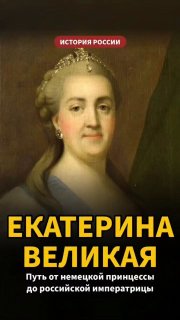
Catherine II the Great (née Sophia Augusta Frederica of Anhalt-Zerbst) was Empress of All Russia, who ruled from 1762 to 1796. His 34-year reign went down in history as the "Golden Age" of the Russian Empire, the age of enlightened absolutism and the grandiose expansion of the country's borders. She came to Russia as a German princess to marry the future Emperor Peter III. In the summer of 1762 she led a coup in the palace, overthrew her husband and seized the throne. She was guided by the ideas of the Enlightenment (corresponded with Voltaire). It divided the country into 50 provinces, strengthened the verticals of power, granted broad privileges to the aristocracy (the "Treaty of Complaint"), but at the same time worked the peasants to the maximum, which resulted in the biggest rebellion of Emilyan Pugachev. She founded the Hermitage, the Imperial Russian Academy, the country's first educational institution for women (Smolny Institute) and public libraries. As a result of successful Russo-Turkish wars and disputes of the Polish-Lithuanian Commonwealth, it annexed Crimea, Novorossia, Azov region, part of Belarus, Lithuania and Ukraine. During this period the army and navy were commanded by the legendary Alexander Suvorov and Fyodor Ushkov. She died in 1796 in St. Petersburg of a stroke, passing the throne to her son Paul I.
Catherine II the Great (née Sophia Augusta Frederica of Anhalt-Zerbst) was Empress of All Russia, who ruled from 1762 to 1796. His 34-year reign went down in history as the "Golden Age" of the Russian Empire, the age of enlightened absolutism and the grandiose expansion of the country's borders. She came to Russia as a German princess to marry the future Emperor Peter III. In the summer of 1762 she led a coup in the palace, overthrew her husband and seized the throne. She was guided by the ideas of the Enlightenment (corresponded with Voltaire). It divided the country into 50 provinces, strengthened the verticals of power, granted broad privileges to the aristocracy (the "Treaty of Complaint"), but at the same time worked the peasants to the maximum, which resulted in the biggest rebellion of Emilyan Pugachev. She founded the Hermitage, the Imperial Russian Academy, the country's first educational institution for women (Smolny Institute) and public libraries. As a result of successful Russo-Turkish wars and disputes of the Polish-Lithuanian Commonwealth, it annexed Crimea, Novorossia, Azov region, part of Belarus, Lithuania and Ukraine. During this period the army and navy were commanded by the legendary Alexander Suvorov and Fyodor Ushkov. She died in 1796 in St. Petersburg of a stroke, passing the throne to her son Paul I.
🇷🇺 Russia · Map
More on Radar
Want to see every report in real time?
Hundreds of sources worldwide, translated into your language, with alerts for what matters to you.
Sign up free Already have an account? Log in