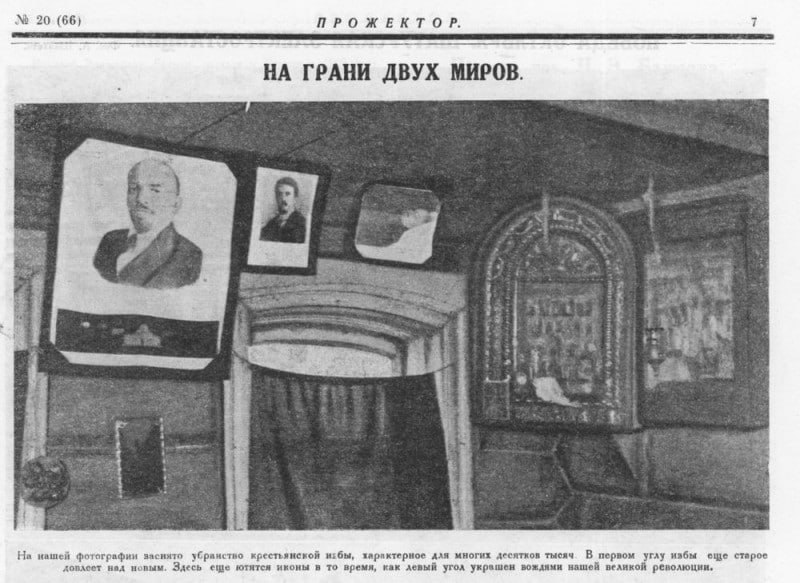
I heard a wonderful story on the Erzamas podcast about how in a Soviet village Komsomol members replaced an icon with a portrait of Lenin, and local old women continued to cross themselves out of habit. It became interesting to what extent this is a historical anecdote, and I discovered an article by the folklorist Andrey Moroz "A Red Corner Without an Icon" (2013), in which exactly such a plot is given. In the Arkhangelsk region, researchers recorded a memory of how a portrait of Vladimir Ilyich Lenin was hung at the entrance to the church instead of the icon of Saint Nicholas. Moreover, the participants in this story clearly enjoyed their trick. Elderly women who came to venerate the saint continued to cross in front of the usual image, even though the leader of the world proletariat was already there. Moroz writes in general about the interesting transformation of the red corner of the village, which in the traditional culture was the main sacred space of the house. After the revolution, icons began to be removed, sometimes by force, and portraits of communist leaders took the vacant place. Moreover, it happened voluntarily, as new political symbols were gradually integrated into the familiar organization of the domestic space. Moroz himself remembers that in 1998 he saw a portrait of Lenin in the red corner of a village hut in the Kargopol region. It is strange that you can find similar stories already in the literature of the 20s. In Vyacheslav Yakovlevich Shishkov's story "Dikulcha" (1929), two women first arrive at the reading shack and begin to cross each other in the front corner, where Lenin's portrait hangs. Moreover, the constable placed it in a seized icon case of the Mother of God, and the church lamp continued to burn in front of the portrait. The result is a rather expressive scene in which the new Soviet culture is placed right inside the old religious form. And it was quite consistent with the actual methods of the first years of Soviet rule.
I heard a wonderful story on the Erzamas podcast about how in a Soviet village Komsomol members replaced an icon with a portrait of Lenin, and local old women continued to cross themselves out of habit. It became interesting to what extent this is a historical anecdote, and I discovered an article by the folklorist Andrey Moroz "A Red Corner Without an Icon" (2013), in which exactly such a plot is given. In the Arkhangelsk region, researchers recorded a memory of how a portrait of Vladimir Ilyich Lenin was hung at the entrance to the church instead of the icon of Saint Nicholas. Moreover, the participants in this story clearly enjoyed their trick. Elderly women who came to venerate the saint continued to cross in front of the usual image, even though the leader of the world proletariat was already there. Moroz writes in general about the interesting transformation of the red corner of the village, which in the traditional culture was the main sacred space of the house. After the revolution, icons began to be removed, sometimes by force, and portraits of communist leaders took the vacant place. Moreover, it happened voluntarily, as new political symbols were gradually integrated into the familiar organization of the domestic space. Moroz himself remembers that in 1998 he saw a portrait of Lenin in the red corner of a village hut in the Kargopol region. It is strange that you can find similar stories already in the literature of the 20s. In Vyacheslav Yakovlevich Shishkov's story "Dikulcha" (1929), two women first arrive at the reading shack and begin to cross each other in the front corner, where Lenin's portrait hangs. Moreover, the constable placed it in a seized icon case of the Mother of God, and the church lamp continued to burn in front of the portrait. The result is a rather expressive scene in which the new Soviet culture is placed right inside the old religious form. And it was quite consistent with the actual methods of the first years of Soviet rule.
🇷🇺 Russia · ארכנגלסק · Map
More on Radar
Want to see every report in real time?
Hundreds of sources worldwide, translated into your language, with alerts for what matters to you.
Sign up free Already have an account? Log in