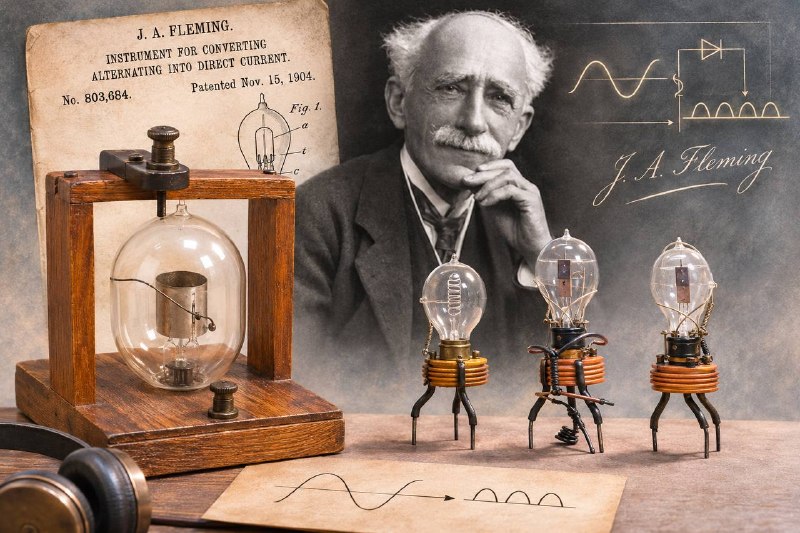
How an ordinary light bulb introduced the age of electronics to humanity.
In 1883, Thomas Edison was trying to solve a rather prosaic problem: his light bulbs were failing too quickly. While experimenting with the design, he placed another metal plate inside the glass bottle and discovered a strange phenomenon. If a positive voltage was applied to it, an electric current began to flow between the hot wire and the plate. And only in one direction.
Edison patented a method for using this effect, but did not attribute much practical significance to the discovery. After all, he was in the lighting business, not radio communications.
Twenty years later, the British physicist John Ambrose Fleming returned to this phenomenon. At that time, the world was already experiencing the first wireless revolution. Radio waves learned to transmit across seas and oceans, but it was much more difficult to reliably receive weak signals.
Fleming worked as a scientific consultant for the Marconi company and was looking for a way to make radios more reliable. Remembering Edison's experiments, he created a device from a glass bottle with two electrodes, one of which was heated.
On November 16, 1904, Fleming applied for a patent for his invention, the first practical two-electrode vacuum tube.
It was basically an electric valve. Just as a normal water valve only allows water to flow in one direction, Fleming's lamp allowed current to flow in one direction, blocking the opposite movement.
It would seem like a small achievement. But precisely this ability made it possible to convert high-frequency vibrations into signals suitable for detecting radio transmissions.
Then events began to unfold rapidly.
In 1906 the American Lee de Forest added a third electrode to the lamp - a control grid. A weak electrical signal can now be controlled by a much stronger current. Imagine a tiny valve that can be turned to regulate a powerful flow of water.