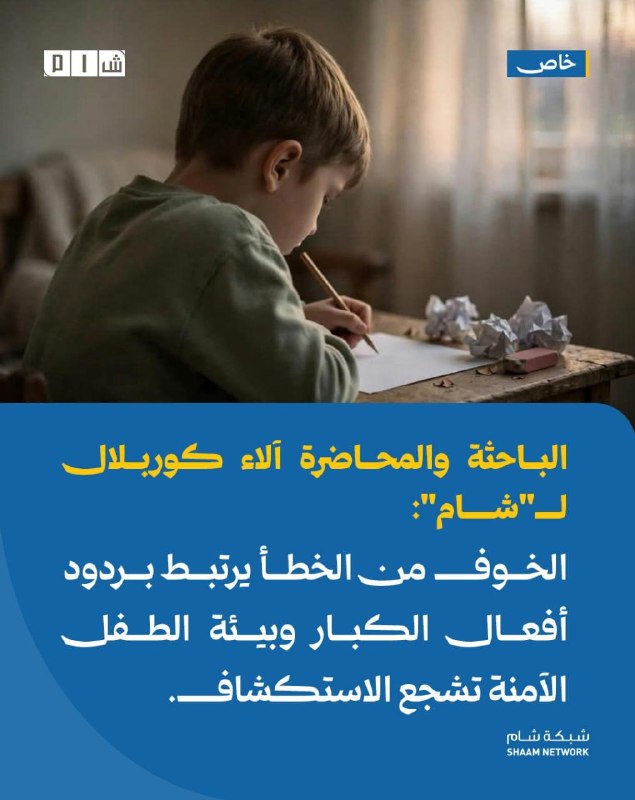
Researcher and lecturer Alaa Korbalal told "Dema": the fear of making a mistake is related to adult reactions, and the child's safe environment encourages exploration.
Researcher and lecturer Alaa Korbalal said, in an interview with Dema News Network, that the fear of making a mistake is not necessarily related to the child's level of intelligence or abilities, but is strongly influenced by the environment in which he grows up and learns.
Korbalal explained that a child who is exposed to criticism for any unsuccessful attempt, or feels that his value is tied to his superiority and achievements, becomes more hesitant to try new things for fear of not reaching the expected result, and pointed out that there are children who fear disappointing parents or teachers and constantly strive to avoid any situation that might reveal their mistake.
The researcher showed that repeated criticism and presence make the child focus more on avoiding mistakes than on learning, which motivates him to prefer silence even when he has the right answer, emphasizing the need to distinguish between correcting inappropriate behavior and making the child feel that his personality or value is the subject of criticism.
Kurbalal noted that the frequent fear of making a mistake pushes the child to doubt his abilities and rely on the approval of others before making decisions, which limits his curiosity and desire to explore. She emphasized that building self-confidence requires supporting the child when his first attempt fails and encouraging him to continue, not just praising him when he succeeds.
The researcher noted, based on her educational experience, that the students' fear appears in the classroom through avoiding participation or avoiding group activities for fear of criticism in front of peers. She explained that the student's silence does not mean his ignorance of the answer or his weak interest, but his need for a safe classroom environment that respects the differences in answers and regards participation as an opportunity to learn, and not as a test to assess his abilities.
Korbalal emphasized that helping a child begins with changing the perception of a mistake as an opportunity to learn, and listening to his ideas without ridicule or prejudgment, and suggested replacing the question "Why did I make a mistake? ” with thought-provoking questions like “What did you learn from this experience? " "What can you do differently? ", while encouraging his courage to try and provide opportunities to make decisions to improve his independence.