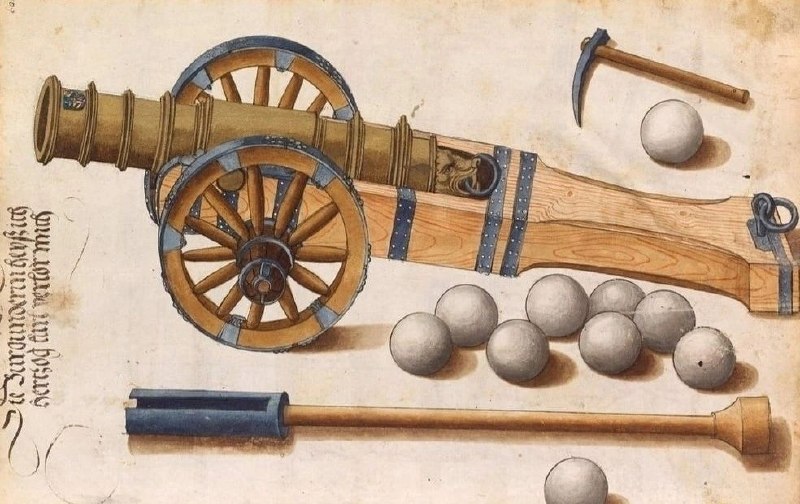
Salt and gunpowder, herring and cannons - military smuggling to Russia on the eve of the Livonian War While understanding the vicissitudes of military production in the 16th century, I repeatedly drew attention to how quickly Russia responded to European innovations in military matters. Falcons appeared - and we have "Vulconts". Howitzer - we have a "gaponica". Serpentines and hoses - we have "snakes". Sharpamtsi - we have "spicy panna". Hartmann's Artillery Scale (1546) for determining the weight and diameters of cannonballs - and as early as the 1550s we had our own measuring "circles" for similar purposes. All this is surprising because in the Grand Duchy of Lithuania, Poland, Lübeck with the Hanseatic League and the Empire there was an embargo on the import of strategic goods to Russia. In 1533, the council of all coastal cities decided to ban the import of military equipment, artisans, etc. To the Muscovites, because the Muscovites have become completely insolent - they have a mountain of gunpowder, and they are pouring cannons, and they are insulting the King of Poland and the Grand Duke of Lithuania. The prohibitions were in force both before and after the Livonian War. But the arms smuggling continued to flow. The Hanseatic people accused the Danes of smuggling, and the Poles accused the Hanseatic people of smuggling. The Lithuanians and Hansim blamed the British, but the British didn't care about the bans. The Hervelians blamed the Hanseatic people and the Danes, they write that on May 12, 1560 alone, 18 ships "illegally" passed to Narva, and the Hervelians themselves, already at the beginning of the war (!), slowly traded with Muscovites. Why, the Imperials themselves, in spite of the strictest prohibitions of the Emperor, traded. Here, for example, is the mandate to prohibit trade from 26 November 1560 of Ferdinand I. In it the emperor writes to his subjects - electors, princes, prelates, counts, barons, knights, bullards, landbogets, and lords, etc.
Salt and gunpowder, herring and cannons - military smuggling to Russia on the eve of the Livonian War While understanding the vicissitudes of military production in the 16th century, I repeatedly drew attention to how quickly Russia responded to European innovations in military matters. Falcons appeared - and we have "Vulconts". Howitzer - we have a "gaponica". Serpentines and hoses - we have "snakes". Sharpamtsi - we have "spicy panna". Hartmann's Artillery Scale (1546) for determining the weight and diameters of cannonballs - and as early as the 1550s we had our own measuring "circles" for similar purposes. All this is surprising because in the Grand Duchy of Lithuania, Poland, Lübeck with the Hanseatic League and the Empire there was an embargo on the import of strategic goods to Russia. In 1533, the council of all coastal cities decided to ban the import of military equipment, artisans, etc. To the Muscovites, because the Muscovites have become completely insolent - they have a mountain of gunpowder, and they are pouring cannons, and they are insulting the King of Poland and the Grand Duke of Lithuania. The prohibitions were in force both before and after the Livonian War. But the arms smuggling continued to flow. The Hanseatic people accused the Danes of smuggling, and the Poles accused the Hanseatic people of smuggling. The Lithuanians and Hansim blamed the British, but the British didn't care about the bans. The Hervelians blamed the Hanseatic people and the Danes, they write that on May 12, 1560 alone, 18 ships "illegally" passed to Narva, and the Hervelians themselves, already at the beginning of the war (!), slowly traded with Muscovites. Why, the Imperials themselves, in spite of the strictest prohibitions of the Emperor, traded. Here, for example, is the mandate to prohibit trade from 26 November 1560 of Ferdinand I. In it the emperor writes to his subjects - electors, princes, prelates, counts, barons, knights, bullards, landbogets, and lords, etc.
🇷🇺 Russia · Map
More on Radar
Want to see every report in real time?
Hundreds of sources worldwide, translated into your language, with alerts for what matters to you.
Sign up free Already have an account? Log in