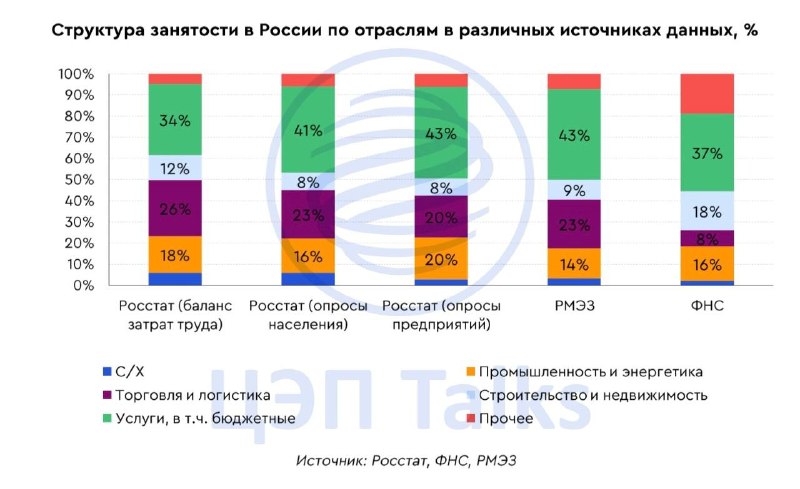
What does the Russian population do? At the beginning of 2026, 120 million people lived in Russia. Over the age of 15. What are these 120 million people doing? A question that is not easy to answer, even with a huge amount of data on the labor market. Let's start with those of them who do not participate in the Russian labor market. Out of these 120 million, it is about 44 million people. These are mainly pensioners who do not work (30 million people), students (6.5 million people), mothers on maternity leave, renters and simply people who do not want to work. You can write a separate post about this category of the population, but today we will not talk about them. According to Rostat estimates (based on population surveys), ~76 million people are active in the labor market. Of these, 2 million people. 74 million people are looking for work. Already have a job (maybe more than one). For example, according to RLMS data, 3-5% of Russians are employed in several jobs at the same time. It is reliable to find out what these 74 million people are doing. Impossible - data from different sources do not completely agree. There are several versions. Organizational version Large and medium-sized organizations (including budget ones) report the satisfaction of 35.8 million jobs (including downtime, forced departure, etc.). Small and micro enterprises provide ~11.2 million jobs. The number of private entrepreneurs in Russia is ~5 million people. In total, according to enterprise estimates, there are about 52 million formal jobs in the Russian economy. Tax version according to the data of the Federal Tax Service for 2024. (when the statistics were opened) only 58 million Russian citizens had wage income (code 2000). Population version according to surveys of a population of 74 million people. ~69 million people are employed in organizations as salaried employees, and ~5 million people. They are sole entrepreneurs and employers. The data do not completely agree. We cannot identify in the data 16-24 million people employed in Russian factories, which probably results from "shadow" employment, work in foreign factories, etc. This complicates a detailed analysis of the Russian labor market.
What does the Russian population do? At the beginning of 2026, 120 million people lived in Russia. Over the age of 15. What are these 120 million people doing? A question that is not easy to answer, even with a huge amount of data on the labor market. Let's start with those of them who do not participate in the Russian labor market. Out of these 120 million, it is about 44 million people. These are mainly pensioners who do not work (30 million people), students (6.5 million people), mothers on maternity leave, renters and simply people who do not want to work. You can write a separate post about this category of the population, but today we will not talk about them. According to Rostat estimates (based on population surveys), ~76 million people are active in the labor market. Of these, 2 million people. 74 million people are looking for work. Already have a job (maybe more than one). For example, according to RLMS data, 3-5% of Russians are employed in several jobs at the same time. It is reliable to find out what these 74 million people are doing. Impossible - data from different sources do not completely agree. There are several versions. Organizational version Large and medium-sized organizations (including budget ones) report the satisfaction of 35.8 million jobs (including downtime, forced departure, etc.). Small and micro enterprises provide ~11.2 million jobs. The number of private entrepreneurs in Russia is ~5 million people. In total, according to enterprise estimates, there are about 52 million formal jobs in the Russian economy. Tax version according to the data of the Federal Tax Service for 2024. (when the statistics were opened) only 58 million Russian citizens had wage income (code 2000). Population version according to surveys of a population of 74 million people. ~69 million people are employed in organizations as salaried employees, and ~5 million people. They are sole entrepreneurs and employers. The data do not completely agree. We cannot identify in the data 16-24 million people employed in Russian factories, which probably results from "shadow" employment, work in foreign factories, etc. This complicates a detailed analysis of the Russian labor market.
🇷🇺 Russia · Map
More on Radar
Want to see every report in real time?
Hundreds of sources worldwide, translated into your language, with alerts for what matters to you.
Sign up free Already have an account? Log in