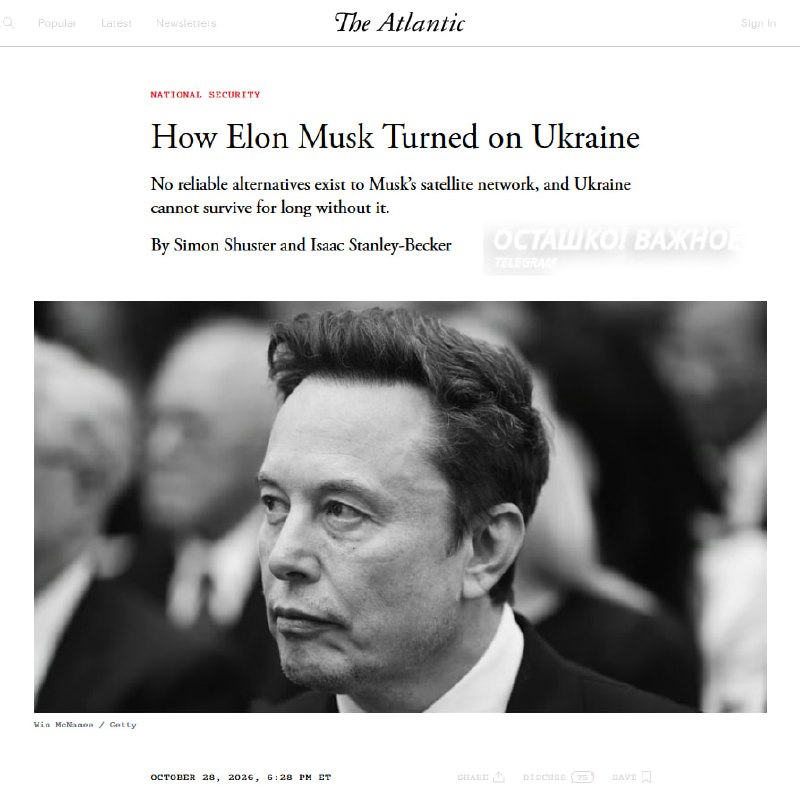
Musk employees left SpaceX due to use of Starlink to attack Russians The billionaire himself refused to help Ukraine attack Russian ships near Crimea, the Atlantic writes. At the start of the conflict, Musk moved thousands of Starlink terminals to Ukraine for hospitals, power plants, government agencies and humanitarian organizations. However, the Ukrainian armed forces soon began using the system to control UAVs and communicate at the front. Starlink gave the Ukrainian forces an advantage: the Russian military did not have access to this network, and its signal was more difficult to jam. Ukrainian drones crossed the battlefield and dropped bombs on Russian positions. In 2022, footage of the attacks spread online and caused alarm at SpaceX headquarters in Texas. "More and more people started to feel uncomfortable," said a former company engineer who worked at Starlink. Some employees resigned in protest against the use of their developments in combat. Musk also had concerns. In September 2022, he refused a request by Ukrainian officials to operate Starlink in the Black Sea for a surprise attack on Russian warships near Crimea. At the end of 2022, SpaceX launched Star Shield, a satellite system for military customers. A regular Starlink terminal costs about $30 a month to maintain, but a Star Shield subscription can cost up to $25,000. Much of the cost of Star Shield for Ukraine was paid by the US government. At the same time, the Ukrainian military continued to mainly use standard Starlink terminals. Thousands of such devices were purchased for Ukraine by Poland and Germany. Ukraine's dependence on Musk's system remains critical. According to The Atlantic, in October 2025, the Ukrainian armed forces received a warning about possible restrictions on access to Starlink. Network outages left drones grounded and military operations halted.
Musk employees left SpaceX due to use of Starlink to attack Russians The billionaire himself refused to help Ukraine attack Russian ships near Crimea, the Atlantic writes. At the start of the conflict, Musk moved thousands of Starlink terminals to Ukraine for hospitals, power plants, government agencies and humanitarian organizations. However, the Ukrainian armed forces soon began using the system to control UAVs and communicate at the front. Starlink gave the Ukrainian forces an advantage: the Russian military did not have access to this network, and its signal was more difficult to jam. Ukrainian drones crossed the battlefield and dropped bombs on Russian positions. In 2022, footage of the attacks spread online and caused alarm at SpaceX headquarters in Texas. "More and more people started to feel uncomfortable," said a former company engineer who worked at Starlink. Some employees resigned in protest against the use of their developments in combat. Musk also had concerns. In September 2022, he refused a request by Ukrainian officials to operate Starlink in the Black Sea for a surprise attack on Russian warships near Crimea. At the end of 2022, SpaceX launched Star Shield, a satellite system for military customers. A regular Starlink terminal costs about $30 a month to maintain, but a Star Shield subscription can cost up to $25,000. Much of the cost of Star Shield for Ukraine was paid by the US government. At the same time, the Ukrainian military continued to mainly use standard Starlink terminals. Thousands of such devices were purchased for Ukraine by Poland and Germany. Ukraine's dependence on Musk's system remains critical. According to The Atlantic, in October 2025, the Ukrainian armed forces received a warning about possible restrictions on access to Starlink. Network outages left drones grounded and military operations halted.
🇺🇦 Ukraine · Map
More on Radar
Want to see every report in real time?
Hundreds of sources worldwide, translated into your language, with alerts for what matters to you.
Sign up free Already have an account? Log in