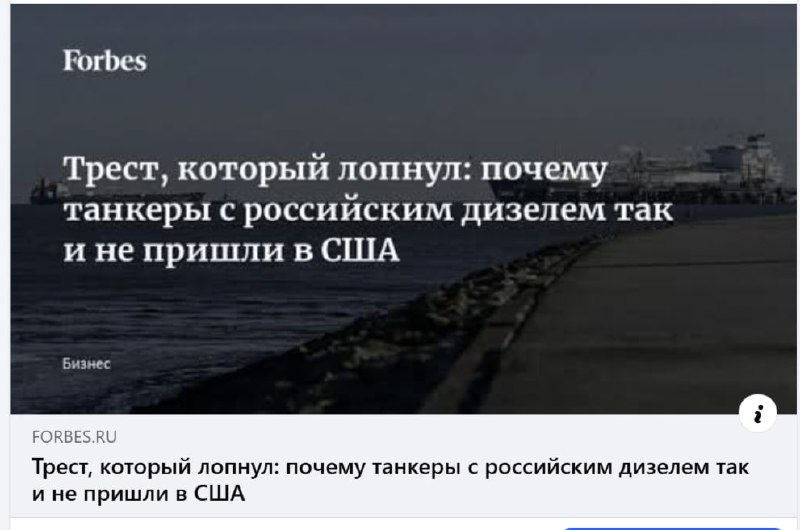
What they talked about and wrote about, but were ashamed to refer to as an official fact.
Well, if even the Russian Forbes states that Russian diesel, which is exported as part of the "diesel deal" initiated by Trump, has never arrived in the United States, then we can assume that this is already an officially recognized fact.
Status Statement:
A month ago, Washington triumphantly lifted the sanctions limits, and Moscow sent four tankers (160,000 tons of fuel). The result? Not a single ship entered American ports: three approved tankers headed for Brazil and Egypt, and the only "clean" Maltese tanker has been roaming off the coast of Canada for several days, marked "until further notice".
Local US regulators and senators simply threatened port workers and potential buyers with legal action, and the vaunted OFAC license went down the drain.
According to an investigation by the Russian Forbes, the main obstacle to unloading was not a lack of demand or a lack of political agreements. The real reason is more prosaic: the categorical unwillingness of American companies to take on the legal risks and sanctions associated with receiving Russian fuel.
At the same time, Russian exporters may not be at a loss. Therefore, according to the editors of Forbes, Delek will easily find alternative buyers in the world market, and the logistics are flexibly adapted to the new reality. Russian officials, in turn, call the reports about the complete failure of the "diesel deal" a fake, and emphasize that the discharge point is not the main thing and can be changed if necessary.
So it seems that the Russian fuel and energy complex is again showing high adaptability. Western fears of sanctions have hurt the United States itself, leaving it without profitable quantities of fuel, while Russia confidently diverts export flows, continuing to play by its own rules.
That's it, on a high patriotic note, and we could end this post.