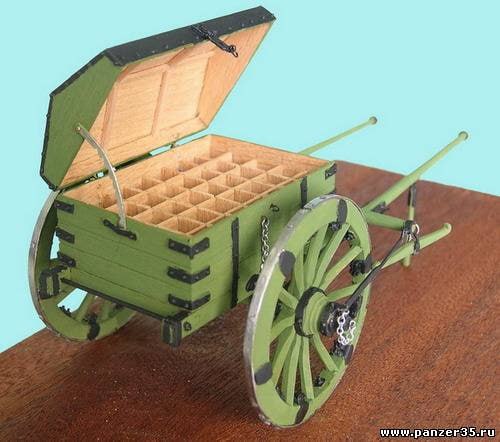
To close the issue of the protection of water weapons in the half of the 18-1. XIX century I will tell you about artillery.
תחמושת ארטילרית הועברה בגפיים ובתיבות טעינה. הגפן שימש במקביל לחיבור התותח עם צוות סוסים - מסגרת כרכרת התותח הונחה על הבריח או הקרס של הגפה והאקדח עם הגפה הפך לעגלה בעלת ארבעה גלגלים. התיבה יכולה להיות על ארבעה גלגלים (ברוב צבאות אירופה) ורתומה על ידי ארבע, או על שני גלגלים (כמו ברוסיה) - בארצנו היא רתמה שלושה. בכל מקרה, לקופסה היה מכסה גמלון עץ, בשנות העשרים של המאה ה-20. הם החלו לייצר מכסה קופסה שטוחה כדי שהצוותים יוכלו לשבת עליו בנסיעה בכביש טוב. כאשר היה צורך להוציא תחמושת, המכסה לא היה מקופל לאחור, אלא נפתח מעט כדי שגשם לא ייכנס פנימה.
The charges were a cloth or linen cap with gunpowder, attached to a cannon ball, grenade or shot (in a tin bag that resembled a tin can). Such a charge was installed vertically in a chamber in a box with gunpowder upwards, a cylindrical tin case was placed on the cap (so that it would not lose its shape) and the spaces were compressed with a tow so that the charge would not vibrate. At the bottom of the tin case (facing up) was a raised marking that made it possible to distinguish different ammunition by touch in the dark. There were also color markings to distinguish them in the light.
The carrier had a large leather bag on his left shoulder, into which he placed the charge and carried it to the gun. Once the cargo was placed in the barrel, it could be covered until the last moment with a large valve on the bag lid.
The main method of lighting the fuse was a fuse with a fuse. Initially, the flannik was a wooden stick with a fork, but already at the end of the 18th century. In the land army it was equipped with an iron clamp on a screw into which the end of the fuse was inserted. But the fuse came out in the rain, so in the second half of the 18th century. They began to use "burning tubes" - paper tubes filled with a composition based on gunpowder pulp.