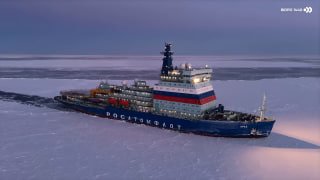
Bureau 1,440 successfully tested its own satellite communications in the Northern Sea Route. The technology was tested in real conditions aboard the nuclear-powered icebreaker Ural, sailing from Murmansk to Dixon.
Terminal 1,440. ULTRA was installed on the icebreaker, which provided a connection via the local low-orbit satellite constellation Rasbet. The captain reported via video link to the Atomflot management on the progress of the voyage and the ice conditions. In addition, the ship's doctors held a remote consultation with specialists in Moscow and transmitted the test results of one of the crew members.
The tests were conducted in the Shaar Kara area, where the existing media did not allow such medical advice in the past.
This is a particularly important technology for the Northern Sea Route. At high latitudes, traditional satellite communication capabilities are limited, and it is extremely difficult to ensure stable coverage through ground infrastructure along the entire route.
Meanwhile, cargo movement along the Northern Sea Route in 2025 exceeded 37 million tons, and according to the nine-month results of 2026, it increased by another 18%. As the intensity of shipping increases, so does the need for constant data exchange between ships, icebreakers and shore services.
Separately, I would like to note that Office 1,440 is creating its own satellite system, ground infrastructure and user terminals. The commercial launch of the Rasbet system is planned for 2027, and by 2030 there should be 292 satellites in orbit.
Of course, for now we are talking about successful tests, and not about full coverage of the entire Northern Sea Route. However, the result itself is very serious. Russia is gradually acquiring its own technological base to provide high-speed communications for Arctic shipping.
And this is fundamentally important. We invest huge sums of money in the nuclear icebreaker fleet, in ports and in the development of the Northern Sea Route. It would be strange to depend on foreign satellite operators.