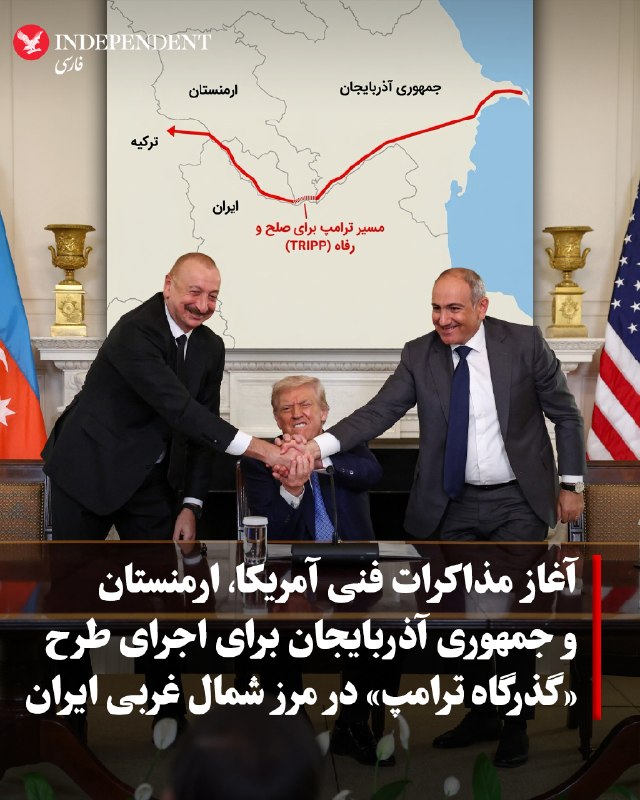
On Saturday, November 7, the governments of the United States, Armenia, and the Republic of Azerbaijan announced the formal launch of trilateral technical working groups to advance the Trump Path to International Peace and Prosperity (TRIPP) project. According to this statement, which was issued in the presence of the US Assistant Secretary of State and the Deputy Foreign Ministers of Armenia and the Republic of Azerbaijan, this mechanism brings together policy makers and technical experts of the three countries to accelerate the process of building this multifaceted transition based on the peace agreement of August 8, 2025. The parties agreed that in the first phase two special working groups in the fields of "transportation" and "electricity transmission" will begin their activities to solve complex technical issues and connect this route to regional infrastructures, and emphasized their joint commitment to the rapid implementation of all aspects of this corridor. Meanwhile, Ali Akbar Velayati, Mujtaba Khamenei's adviser, on Thursday, November 5, in response to the approval of the "Trump Pass" agreement in the Armenian parliament, threatened America and its allies. Valiati wrote that he told the Armenian ambassador that if Trump and his allies cross Iran's red lines, "we will break their legs."
The political basis for this plan was laid on August 8, 2025 at a meeting in Washington in the presence of Donald Trump, Pashinyan and Ilham Aliyev. The following framework agreement envisages the establishment of a joint venture with a share of 74% from the American side and 26% from Armenia. The initial period of project development rights is 49 years and can be extended for another 50 years. In the framework of the cooperation, railways, roads and energy and communication infrastructures are defined. The history of the dispute over this route goes back to the ceasefire agreement of the Nagorno-Karabakh war in November 2020. In the ninth paragraph of that agreement, reopening of the economic and transportation ties in the region and ensuring the security of transportation between the main part of the Republic of Azerbaijan and Nakhchivan was expected to monitor the way of monitoring and limiting the dispute over power. The Armenian government has made the issue one of the focal points of the competition in the South Caucasus.