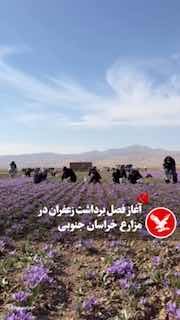
With the beginning of the saffron harvest season in Iran, pictures of the fields of South Khorasan and the activities of farmers in this province were published. This product, known as red gold, is harvested every year from the end of October to the beginning or middle of December, and after separating the red stigmas of the flowers and drying them, it is marketed. South Khorasan is one of the most important saffron production centers in Iran, and along with Razavi Khorasan it has a large contribution to the production of this product. Saffron is one of Iran's most valuable agricultural and export products, and its cultivation is a source of income for many rural families in the production areas. According to the 2025 report of the Food and Agriculture Organization of the United Nations (FAO), Iran is the largest producer of this product, producing about 85-90% of the world's saffron. However, water shortages, climate change and problems related to processing and marketing are among the challenges for saffron producers in Iran.
With the beginning of the saffron harvest season in Iran, pictures of the fields of South Khorasan and the activities of farmers in this province were published. This product, known as red gold, is harvested every year from the end of October to the beginning or middle of December, and after separating the red stigmas of the flowers and drying them, it is marketed. South Khorasan is one of the most important saffron production centers in Iran, and along with Razavi Khorasan it has a large contribution to the production of this product. Saffron is one of Iran's most valuable agricultural and export products, and its cultivation is a source of income for many rural families in the production areas. According to the 2025 report of the Food and Agriculture Organization of the United Nations (FAO), Iran is the largest producer of this product, producing about 85-90% of the world's saffron. However, water shortages, climate change and problems related to processing and marketing are among the challenges for saffron producers in Iran.
🇮🇷 Iran · Map
More on Radar
Want to see every report in real time?
Hundreds of sources worldwide, translated into your language, with alerts for what matters to you.
Sign up free Already have an account? Log in