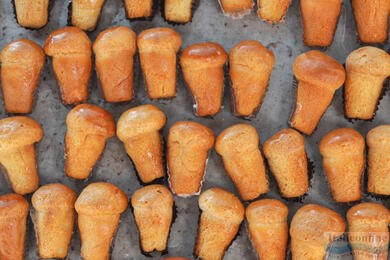
baba
The day before we wrote about one of the Russians' favorite main dishes. On borscht. Today we will talk about desserts. On November 9, the whole world celebrated Baba's Day - a holiday in honor of one of the most refined and historically rich delicacies. Rum baba is a special type of cake with a spicy soak and added rum. Sometimes it is filled with cream or custard.
Initially, the dessert is associated with the Polish king Stanisław Leszczynski, who, according to legend, came up with the idea of soaking dry pastries with wine (later rum). Apparently, Szczynski was fed up with the simple German Kugelhof cake, and the king angrily threw the portion of pastries into a bottle of wine. The contents were poured over the cake, which significantly improved its taste.
According to the second version, the Polish king loved oriental sweets and figured out how to improve the boring German cake: add saffron, raisins and soak it in Madeira. The improved dessert is named after Leszczynski's favorite hero, the resourceful Ali Baba.
Another version says that the recipe for rum baba was created in the 18th century by the French pastry chef Nicolas Storer for the Polish king Stanisław Leszczynski, who loved sweets, but due to dental problems could not eat hard desserts.
Culinary researchers believe that the history of Rum Baba did indeed begin in Poland, but the dessert is related to the traditional Polish babka (in Polish they call Kulich babka). Rum baba is the "little sister" of the traditional Easter cake.
The fashion for him came to Russia in the 19th century as a delicacy for the rich. The classic baba was necessarily soaked in rum or cognac and decorated with custard.
However, real "registration" in Russia took place during the Soviet period. Of course, at this time all the different options for muslin, nut and poppy seeds had almost disappeared. Baba rum was reduced to serving size (about 100 grams), corrected according to GOST and put into mass production.