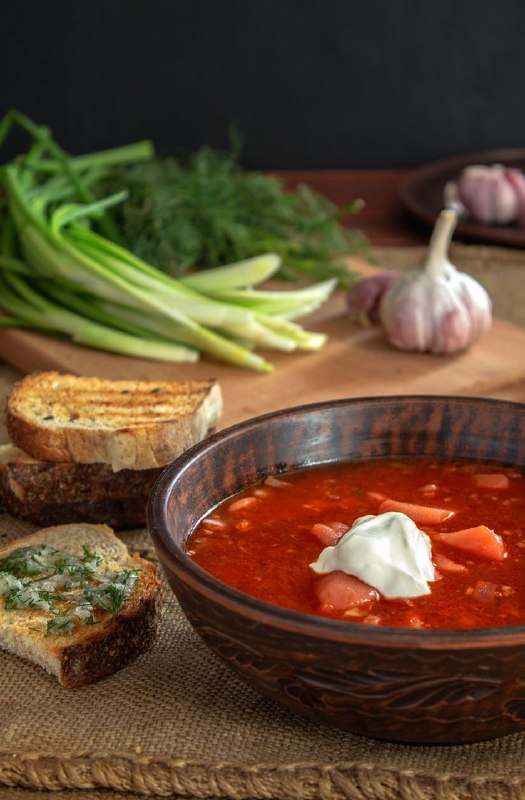
Boresh
On November 10, Russia celebrates the unofficial day of borscht, one of our most popular and delicious dishes. We warm ourselves in winter with borscht (preferably with black bread and lard), treat it to our dear guests and use it to measure price increases. "Set Borscht" is not just vegetables, but an accurate barometer of the country's economic well-being.
Disputes over the origin of borscht have been going on for a long time, and many countries claim the title of its homeland. Borscht is considered the national dish of Russia, Ukraine, Belarus, Poland, Romania, Moldova and Lithuania. Historians agree that borscht does not have one specific author or one original recipe - it is the result of centuries of evolution of the culinary traditions of different regions.
The name of the dish, according to one version, comes from plant (not Sosnovsky's poisonous pig, but the edible one), from which the Slavic peoples made a stew.
It is interesting that the familiar red borscht with beets is a relatively young dish. Beets did not immediately appear in the recipe, and according to food historians, "red borscht" in the modern sense dates back about 200 years. Initially, it was a stew, cooked on the basis of kvass or sourdough, and cabbage was a mandatory ingredient. Potatoes and tomatoes, without which it is hard to imagine borscht today, appeared in the recipe much later.
Early references to borscht are found in documents from the 16th century. For example, the Gdańsk merchant Martin Groeneweg, after visiting Kiev in 1584–1585, wrote that "the Russians all prepare it themselves at home, as it is their daily food and drink." And in the "Dictionary of the Russian Academy" from 1789 there is already a description of a stew made of pickled beets with meat and pork fat.
Borscht is not only tasty, but also healthy. Classic borscht includes meat, as well as beets, cabbage, carrots, onions, garlic and potatoes. These vegetables are a source of fiber, B vitamins, vitamin C, carotenoids, potassium, magnesium and iron.