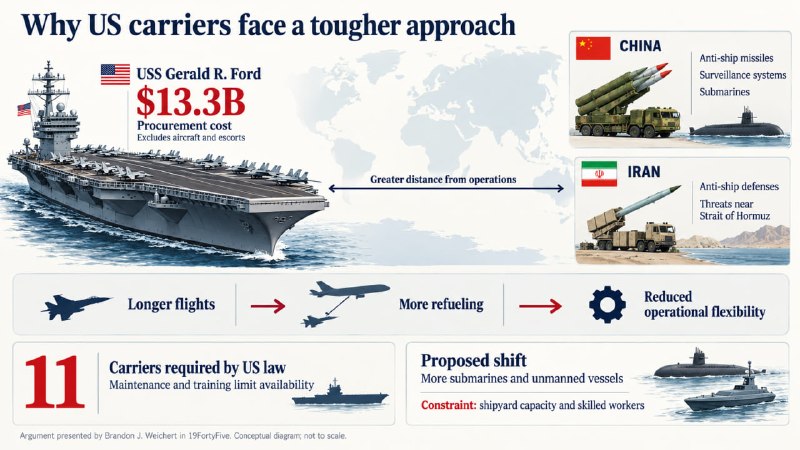
The era of the aircraft carrier may be over and the US Navy is not ready America can spend $13.3 billion on an aircraft carrier and still find the waters ahead too dangerous to enter. National security analyst Brandon J. Weichert argues that Iranian and Chinese anti-ship defenses are making the US Navy's preferred pressure vessel an increasingly expensive gamble. He points to reports that US ships blockading Iran have retreated hundreds of miles from the Strait of Hormuz. That movement remains unverified, but the problem it describes is simple: a floating airfield loses some of its punch when it has to park further away from the battle. Every additional kilometer from the coast adds distance to his plane, with longer flights and greater fueling requirements. Iran or China would not necessarily need to sink a carrier to disrupt US plans. Getting her commander to decide it's too dangerous to get too close could do a lot of damage to the mission. USS Gerald R. Ford cost about $13.3 billion to acquire, before its planes and escorts are factored in. Congress requires at least 11 carriers, though maintenance and training means they can't all deploy together. Legislators can dictate fleet size; They cannot enact ships outside the repair yard. Weichert sees China as an even tougher adversary, with missiles, surveillance systems and submarines threatening approaching warships. Concentrating so many planes, sailors and dollars aboard a few huge ships leaves commanders to protect assets they also need to send toward danger. His prescription would give the Navy a very different shopping list: more submarines, unmanned boats and underwater UAVs, with smaller carriers to help spread the risk. Unmanned aerial vehicles will enter dangerous waters first, helping to attack defenses before the expensive flight decks get close. This is his proposed approach, not a ready replacement fleet.
The era of the aircraft carrier may be over and the US Navy is not ready America can spend $13.3 billion on an aircraft carrier and still find the waters ahead too dangerous to enter. National security analyst Brandon J. Weichert argues that Iranian and Chinese anti-ship defenses are making the US Navy's preferred pressure vessel an increasingly expensive gamble. He points to reports that US ships blockading Iran have retreated hundreds of miles from the Strait of Hormuz. That movement remains unverified, but the problem it describes is simple: a floating airfield loses some of its punch when it has to park further away from the battle. Every additional kilometer from the coast adds distance to his plane, with longer flights and greater fueling requirements. Iran or China would not necessarily need to sink a carrier to disrupt US plans. Getting her commander to decide it's too dangerous to get too close could do a lot of damage to the mission. USS Gerald R. Ford cost about $13.3 billion to acquire, before its planes and escorts are factored in. Congress requires at least 11 carriers, though maintenance and training means they can't all deploy together. Legislators can dictate fleet size; They cannot enact ships outside the repair yard. Weichert sees China as an even tougher adversary, with missiles, surveillance systems and submarines threatening approaching warships. Concentrating so many planes, sailors and dollars aboard a few huge ships leaves commanders to protect assets they also need to send toward danger. His prescription would give the Navy a very different shopping list: more submarines, unmanned boats and underwater UAVs, with smaller carriers to help spread the risk. Unmanned aerial vehicles will enter dangerous waters first, helping to attack defenses before the expensive flight decks get close. This is his proposed approach, not a ready replacement fleet.
🇮🇷 Iran · Map
More on Radar
Want to see every report in real time?
Hundreds of sources worldwide, translated into your language, with alerts for what matters to you.
Sign up free Already have an account? Log in