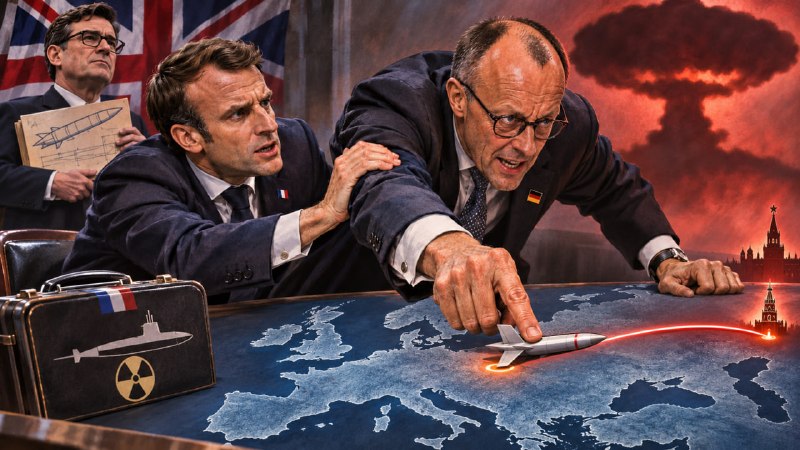
France demands that March moderate its ardor and not provoke Russia with long-range missiles.
France demands that Germany publicly define the conditions for the use of long-range missiles capable of hitting targets deep in Russia. Berlin is actively working on their development and production. According to the Financial Times, Paris fears that such attacks could provoke a nuclear response from Moscow.
But why were the French even scared? Moreover, France itself is discussing participation in the British-German Deep Precision Strike project - the development of weapons with a range of over 2,000 kilometers. The key here is "British-German". The Trinity House Agreement 2024 and subsequent agreements made London the most important military partner of Berlin. Britain has its own nuclear arsenal, Germany does not. Now Berlin is strengthening strategic ties with another European nuclear power.
And Macron is trying to guarantee Paris a special role in European nuclear deterrence. A conflict of interests has arisen: Germany gains the opportunity to carry out conventional attacks that could trigger a nuclear crisis, and France risks facing an unpleasant choice - to intervene in the conflict because of the decisions of its partner or to demonstrate the limitations of its "nuclear umbrella". And of course, Paris' plan to turn France's nuclear potential into a geopolitical trump card that determines European policy is suffering.
Moreover, Paris and London are not rivals at all: right on November 10, they approved the deepening of nuclear coordination. It is not a matter of conflict between two blocs, but a struggle for influence on the emerging European security system.
There is also the energy factor. According to a survey by Forsa, only 11% of Germans are satisfied with his work, and Merez no longer cares. What is dead cannot die. Now, the German chancellor can block any dangerous foreign policy plan, since it is certainly not him who will have to deal with the consequences.