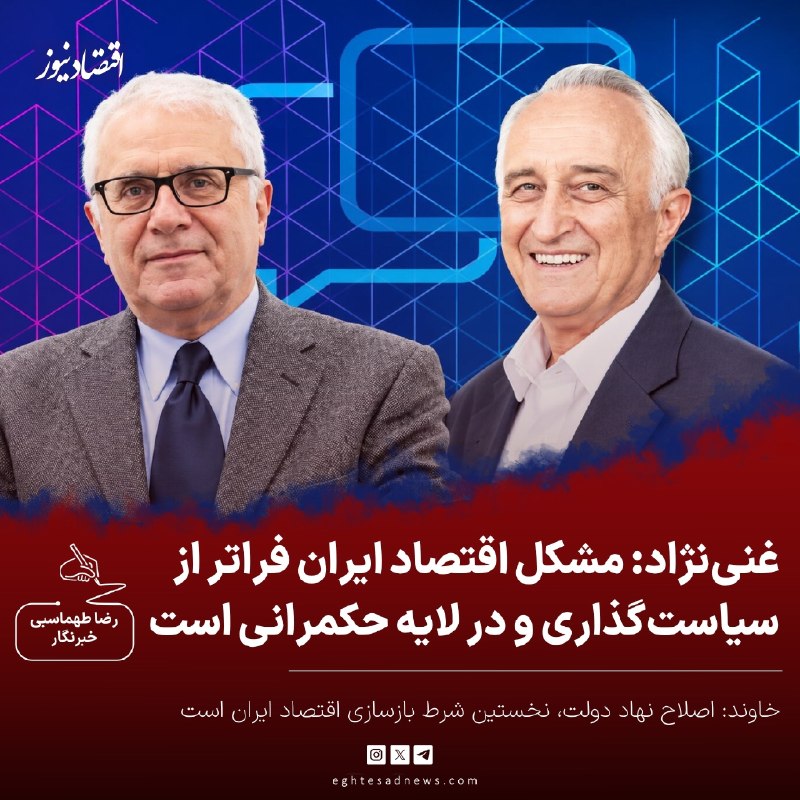
Ghanijad: The problem of Iran's economy is beyond policy-making and at the level of the government. Mozahid: reforming the government institution is the first condition for the restoration of Iran's economy. Feridon Hwand and Musa Ghanijad, who are re-reading the book "Economics in Lesson" by Henry Hazlitt at the weekly round table of Tejarat Farda, say that the policies that bring popularity in the short term sometimes impose heavy long-term costs on society; Because they favor the interests of specific groups over the general interests and sustainable achievements. Husband: Hazlit raises two issues in the economics book in one lesson; One is why states and governments favor the interests of certain groups over the general interests. That is, they meet the needs and demands of a particular group with their own economic policies and ignore the collective interests. The second issue is why long-term benefits are sacrificed for short-term benefits. Economic recommendations must be weighed against the history and conditions of each country. Temporary support for start-up industries can help them grow, but if not accompanied by gradual liberalization and preparation for competition, it will leave the industries dependent on the government; The experience of Germany, Japan, South Korea and Iran confirms the importance of this difference. Ghani Nejad: Our current economic crisis goes back exactly to the central words of Hezlit in this book, which say that a politician does something that the public is happy with in the short term, but because the cost of this work appears in the long term, it becomes clear later how bad this policy was. Like the mandatory pricing policy which is the usual work of governments in Iran to prevent price increases. Policies such as price stabilization, mandate currency, and subsidies from bank sources are examples of short-term decisions that are pleasant at first, but as liquidity rises, inflation, rents, and production weaken, they end up at the expense of the people. Liberalization of prices and interest rates is essential. I see two reasons for continuing a wrong policy. First, which I have mentioned many times, is the ideology that dominates the thinking of politicians and those in power, which is reflected in their decisions. Second, the interests of a few have power and do not allow to create liberalization and competition of the economy. Full details website Yes Instagram.
Ghanijad: The problem of Iran's economy is beyond policy-making and at the level of the government. Mozahid: reforming the government institution is the first condition for the restoration of Iran's economy. Feridon Hwand and Musa Ghanijad, who are re-reading the book "Economics in Lesson" by Henry Hazlitt at the weekly round table of Tejarat Farda, say that the policies that bring popularity in the short term sometimes impose heavy long-term costs on society; Because they favor the interests of specific groups over the general interests and sustainable achievements. Husband: Hazlit raises two issues in the economics book in one lesson; One is why states and governments favor the interests of certain groups over the general interests. That is, they meet the needs and demands of a particular group with their own economic policies and ignore the collective interests. The second issue is why long-term benefits are sacrificed for short-term benefits. Economic recommendations must be weighed against the history and conditions of each country. Temporary support for start-up industries can help them grow, but if not accompanied by gradual liberalization and preparation for competition, it will leave the industries dependent on the government; The experience of Germany, Japan, South Korea and Iran confirms the importance of this difference. Ghani Nejad: Our current economic crisis goes back exactly to the central words of Hezlit in this book, which say that a politician does something that the public is happy with in the short term, but because the cost of this work appears in the long term, it becomes clear later how bad this policy was. Like the mandatory pricing policy which is the usual work of governments in Iran to prevent price increases. Policies such as price stabilization, mandate currency, and subsidies from bank sources are examples of short-term decisions that are pleasant at first, but as liquidity rises, inflation, rents, and production weaken, they end up at the expense of the people. Liberalization of prices and interest rates is essential. I see two reasons for continuing a wrong policy. First, which I have mentioned many times, is the ideology that dominates the thinking of politicians and those in power, which is reflected in their decisions. Second, the interests of a few have power and do not allow to create liberalization and competition of the economy. Full details website Yes Instagram.
🇮🇷 Iran · Map
More on Radar
Want to see every report in real time?
Hundreds of sources worldwide, translated into your language, with alerts for what matters to you.
Sign up free Already have an account? Log in