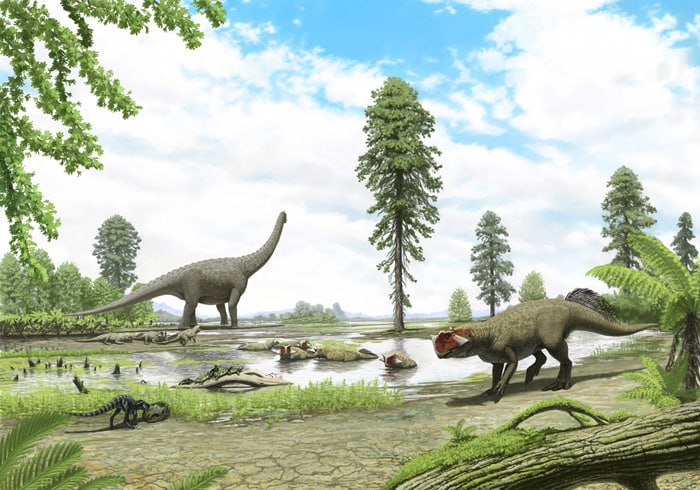
Paleontologists have confirmed that in the era of the Christian system on the lands of the modern Cozbass lived dinosaurs of the most heterogeneous scales 120 million years ago. This was stated by the head of the scientific research department of the Kuzbass State Museum of Local History Dmitry Slybodin. According to him, the archaeological layer of the area contains traces of relatively small grasses with blacks and horned yields, and some that reached twenty meters in length. The expert noted that early fossil discoveries indicate that Philichicorus had four limbs. However, modern studies show that the animal was mainly based on its hind legs. Also, her horn formation continued to grow in size as the human matured. While psittacosaurus resembled modern birds, sauropods had heavy frames with an elongated body, neck and tail. The remains of these giants were discovered in the Kozves region. The length of some specimens reached twenty meters, and the weight of twenty tons. Outwardly, such creatures were inferior to giraffes only in size, while being much heavier. Data on predators in the area are incomplete. Since the discovery of the remains in the summer of 2023, one species has been officially described - the krijacursor. However, the researchers' opinion of what the ancient Siberian ecosystem looked like continues to be refined in the search for new zoological materials. Follow OBKOR.
Paleontologists have confirmed that in the era of the Christian system on the lands of the modern Cozbass lived dinosaurs of the most heterogeneous scales 120 million years ago. This was stated by the head of the scientific research department of the Kuzbass State Museum of Local History Dmitry Slybodin. According to him, the archaeological layer of the area contains traces of relatively small grasses with blacks and horned yields, and some that reached twenty meters in length. The expert noted that early fossil discoveries indicate that Philichicorus had four limbs. However, modern studies show that the animal was mainly based on its hind legs. Also, her horn formation continued to grow in size as the human matured. While psittacosaurus resembled modern birds, sauropods had heavy frames with an elongated body, neck and tail. The remains of these giants were discovered in the Kozves region. The length of some specimens reached twenty meters, and the weight of twenty tons. Outwardly, such creatures were inferior to giraffes only in size, while being much heavier. Data on predators in the area are incomplete. Since the discovery of the remains in the summer of 2023, one species has been officially described - the krijacursor. However, the researchers' opinion of what the ancient Siberian ecosystem looked like continues to be refined in the search for new zoological materials. Follow OBKOR.
More on Radar
Want to see every report in real time?
Hundreds of sources worldwide, translated into your language, with alerts for what matters to you.
Sign up free Already have an account? Log in