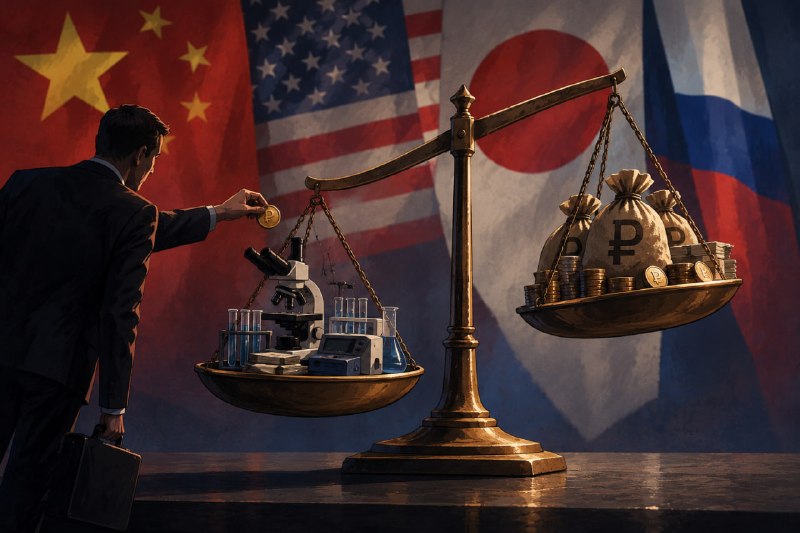
They are in no hurry to feed science: experts revealed that Russia's domestic expenditure on research and development in 2025 amounted to 2.145 trillion rubles, or 1% of GDP. In the previous two years, costs relative to GDP were lower - 0.96% in 2024 and 0.97% in 2023. For the first time, micro-enterprises were included in the calculation, so some of the growth may be methodological. At the same time, in terms of purchasing power parity, this amounts to $72.4 billion. Consequently, our country ranks ninth in the world. Russia has been in the top ten for 15 years. But the leaders are far ahead. For example, China spends $1.04 trillion on science, the United States allocates $1 trillion, and Japan - $233.8 billion. That is, the top two spend about 14 times more than Moscow, which is also slowly changing its funding structure. Government money for science in Russia accounts for 63.4%, or 1.4 trillion rubles. Businesses provide 33.4%, or 717.2 billion. Another 3.2% comes from other sources. The movement is in the right direction, because in 2023 the share of companies reached only 31.2%. Now the volumes are growing, but the pace is about 0.4 percentage points per year, which is low, since in developed countries and China, organizations usually finance significantly more than half of the research. Therefore, on the one hand, Russia remains a scientific superpower in scale, but in its intensity, it is noticeably lower than the leaders. The indicator can be moved not only by the budget, but also by a private customer for research. And growth funds, which Putin previously supported, and delayed investment deductions with a pilot in pharmaceuticals work logically here.
They are in no hurry to feed science: experts revealed that Russia's domestic expenditure on research and development in 2025 amounted to 2.145 trillion rubles, or 1% of GDP. In the previous two years, costs relative to GDP were lower - 0.96% in 2024 and 0.97% in 2023. For the first time, micro-enterprises were included in the calculation, so some of the growth may be methodological. At the same time, in terms of purchasing power parity, this amounts to $72.4 billion. Consequently, our country ranks ninth in the world. Russia has been in the top ten for 15 years. But the leaders are far ahead. For example, China spends $1.04 trillion on science, the United States allocates $1 trillion, and Japan - $233.8 billion. That is, the top two spend about 14 times more than Moscow, which is also slowly changing its funding structure. Government money for science in Russia accounts for 63.4%, or 1.4 trillion rubles. Businesses provide 33.4%, or 717.2 billion. Another 3.2% comes from other sources. The movement is in the right direction, because in 2023 the share of companies reached only 31.2%. Now the volumes are growing, but the pace is about 0.4 percentage points per year, which is low, since in developed countries and China, organizations usually finance significantly more than half of the research. Therefore, on the one hand, Russia remains a scientific superpower in scale, but in its intensity, it is noticeably lower than the leaders. The indicator can be moved not only by the budget, but also by a private customer for research. And growth funds, which Putin previously supported, and delayed investment deductions with a pilot in pharmaceuticals work logically here.
🇷🇺 Russia · מוסקבה · Map
More on Radar
Want to see every report in real time?
Hundreds of sources worldwide, translated into your language, with alerts for what matters to you.
Sign up free Already have an account? Log in