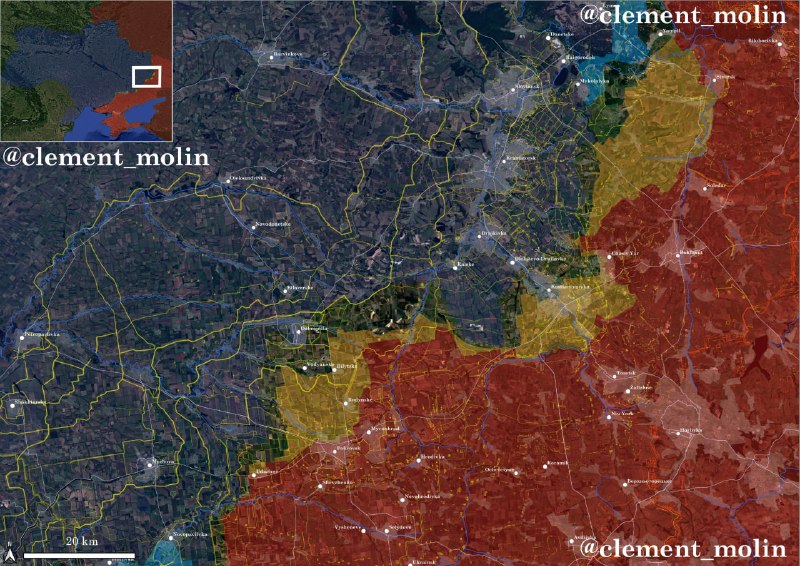
OSINT researcher Clement Mullen commented on the situation at the front in the Donetsk region. He points out that the situation here is more complex for Ukraine than in Zaporozhye, although even here it was possible to slow down the Russian advance and stabilize the front in the Slavansk region. At the beginning of 2026, the Ukrainians abandoned their positions in Pokrovsk and Mirnograd, after which the Russians, with four armies along a section of 50 kilometers from the front, launched an attack towards Dobropolia. At the same time, the Russians stopped for the time being the attempts to advance towards the western administrative borders of the Donetsk region and towards Druzhkovka. Infiltration is the main Russian tactic in Dobropolia and sometimes reaches the city center. The city is of great importance to the current war, and may even open the way for an attack on Brevinkovo, although this is an unlikely scenario given the strength of the Ukrainian fortifications. The battle for Konstantinovka has been going on for more than a year, the positions are mixed with each other. The Russians maintain an advantage in the positions of about 50% of Konstantinovka, the Ukrainians - about 15%; In the remaining 35% of the city, it is difficult to say who has an advantage in holding territory. For Slavyansk and Kramatorsk the situation gradually worsened during 2026, although in September the Russians were pushed out of these cities. However, the threat of drone strikes and air bombs on Slavansk and Kramatorsk led to the evacuation of tens of thousands of people in previous months. Mullen notes that despite Russian progress, the situation in Ukraine still looks better than it did in the spring. The factor that works against the Russian command is that they have no room for maneuver: they have approached large cities and fortification lines, and then can only take them head-on. In the coming months, it will become clear how successful Ukraine is in containing the Russian advance in Dobropilia and how successful its attempts to stabilize the front will be.
OSINT researcher Clement Mullen commented on the situation at the front in the Donetsk region. He points out that the situation here is more complex for Ukraine than in Zaporozhye, although even here it was possible to slow down the Russian advance and stabilize the front in the Slavansk region. At the beginning of 2026, the Ukrainians abandoned their positions in Pokrovsk and Mirnograd, after which the Russians, with four armies along a section of 50 kilometers from the front, launched an attack towards Dobropolia. At the same time, the Russians stopped for the time being the attempts to advance towards the western administrative borders of the Donetsk region and towards Druzhkovka. Infiltration is the main Russian tactic in Dobropolia and sometimes reaches the city center. The city is of great importance to the current war, and may even open the way for an attack on Brevinkovo, although this is an unlikely scenario given the strength of the Ukrainian fortifications. The battle for Konstantinovka has been going on for more than a year, the positions are mixed with each other. The Russians maintain an advantage in the positions of about 50% of Konstantinovka, the Ukrainians - about 15%; In the remaining 35% of the city, it is difficult to say who has an advantage in holding territory. For Slavyansk and Kramatorsk the situation gradually worsened during 2026, although in September the Russians were pushed out of these cities. However, the threat of drone strikes and air bombs on Slavansk and Kramatorsk led to the evacuation of tens of thousands of people in previous months. Mullen notes that despite Russian progress, the situation in Ukraine still looks better than it did in the spring. The factor that works against the Russian command is that they have no room for maneuver: they have approached large cities and fortification lines, and then can only take them head-on. In the coming months, it will become clear how successful Ukraine is in containing the Russian advance in Dobropilia and how successful its attempts to stabilize the front will be.
🇷🇺 Russia · דוברופוליה · Map
More on Radar
Want to see every report in real time?
Hundreds of sources worldwide, translated into your language, with alerts for what matters to you.
Sign up free Already have an account? Log in