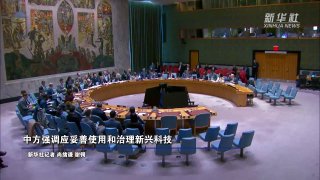
China emphasizes the use and proper management of emerging technologies.
Xinhua News Agency, United Nations, 24 November. China's Permanent Representative to the UN Fu Kong spoke at the Security Council's open debate on "Conflict Resolution in an Era of Rapid Technological Change" on the 24th, stressing that emerging technologies must be properly used and managed.
Fu Kong noted that the current new round of scientific and technological revolution and industrial transformation is accelerating, bringing unprecedented opportunities and challenges to international peace and security. Emerging technologies such as artificial intelligence and unmanned systems can become tools for maintaining peace, or they can become drivers of escalating conflicts. The key lies in whether humans can use them and manage them responsibly. Countries must strengthen unity and cooperation to ensure that emerging technologies always develop in a direction that is good and beneficial to humanity.
Fu Kong said that security risks in technological changes should be shared by all countries, and development dividends should also be shared by all countries. We must actively carry out economic cooperation and international trade and scientific and technological exchanges, jointly create an open, inclusive, beneficial scientific and technological development environment for all and without discrimination, effectively protect the legitimate rights of all countries to use science and technology peacefully, and avoid including national security, building technical barriers and inciting conflict in the camp. It is necessary to promote the bridging of the technological gap, to support the global south in catching up and to achieve leapfrogging development with the help of scientific and technological power. There is a need to support the UN in fulfilling its role as the primary channel for global science and technology governance and to promote the formation of a widely agreed governance framework and standards.
Fu Kong stressed that no matter how science and technology change, all countries should always adhere to the people-centered approach, regard safety and control as the bottom line requirement, and prevent the abuse and misuse of technology. We must abide by the purposes and principles of the United Nations Charter and relevant international laws, and oppose the use of technological advantages to undermine the sovereignty of other countries and interfere in the internal affairs of other countries. It is necessary to actively respond to the endogenous and derivative risks of artificial intelligence and ensure that artificial intelligence is always under human control. Terrorist organizations and extremist forces must be prevented from relying on new technologies to carry out activities, and false information and hate speech must be prevented from undermining social stability and interfering with the peace process.
Fu Kong noted that the peaceful settlement of international disputes is a basic principle of the United Nations Charter and the only way to achieve sustainable peace and universal security. In the era of technological changes, the cycle of acquiring information and making decisions has become very compressed. The more information-rich and urgent the situation becomes, the more the parties must maintain calm and restraint, demonstrate responsibility, provide sufficient windows for diplomatic mediation and reserve enough space for the path of peace.
Fu Kong said that as a fertile ground for innovation and a responsible country, China actively promotes the transformation of scientific and technological progress into people's livelihood and benefits, and shares development opportunities with the world. China is willing to work with all parties to build a fair and reasonable global science and technology governance system, so that scientific and technological changes can inject a strong impetus for world peace and development.