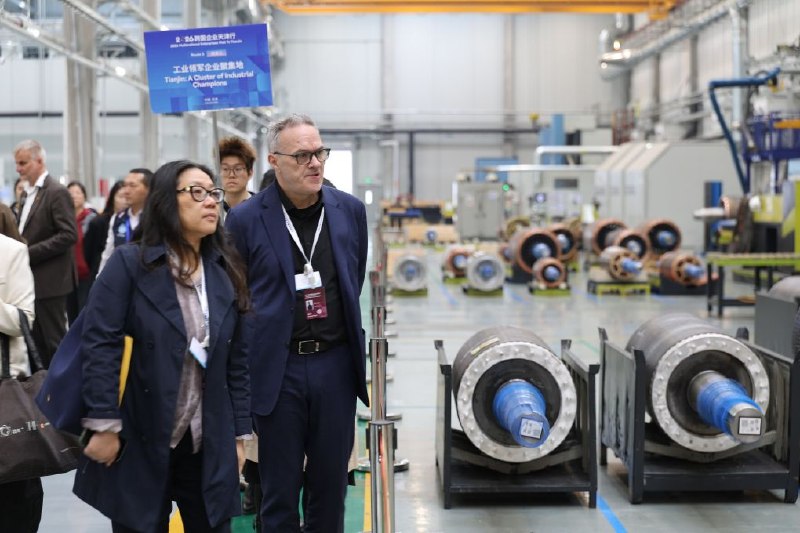
Why do many German companies invest in China? Xinhua News Agency, Tianjin, October 24. Title: Why are many German companies investing in China? Xinhua News Agency correspondents Sister Liang and Shir Rui at the "Multinational Enterprise Tour in Tianjin" event that just ended in 2026, Inmonda Co., Ltd., the world's leading large engine and transmission supplier, signed a contract with the Tianjin Economic and Technological Development Zone Management Committee and CITIC Heavy Industry, a large heavy equipment company under CITIC Group, to reach a research cooperation, Delivery of new technology and new technologies and new technologies. transformation. "China is building the largest and fastest growing renewable energy system in the world. Green power will accelerate the re-electrification of industry, creating huge demand for high-efficiency engines and large-scale propulsion systems. Currently, the deep integration of AI and energy transformation is injecting new momentum into China's green and low-carbon economy. We hope to build a cutting-edge technology system in China and with all technological parties in China." said Shay Venka, Global President of Inmunda's High Voltage Products and Systems Division. According to the data of the Federal Statistical Office in Germany, in the first half of the year China continued to remain Germany's largest trading partner, with the volume of bilateral trade reaching 125.5 billion euros. A report by the German Economic Institute indicated that German companies will invest around 7 billion euros in China in 2025. In China, a group of German companies are showing their long-term confidence in the Chinese market by continuing to increase capital, expand production and localize R&D. In the production workshop of Kern-Liebers Precision Technology (Tianjin) Co., Ltd., automatic equipment runs efficiently and precision springs roll off the production line in an orderly fashion. These products are widely used in advanced manufacturing fields such as automotive, medical technology and industrial automation. Holly, vice president of Kernlibers China Enterprise Management Center, placed a golden micro spring in his palm and said: "With only 1 gram of metal, the company can produce up to 20,000 micro springs." In August of this year, Carnibus, which has a history of 138 years, completed the second phase expansion project of its Tianjin factory, with an additional investment of 120 million yuan, while introducing the group's advanced production technology and automatic production solutions in the field of smart springs. The new production line of its medical spring will become the group's most advanced similar production line in the world. Eric Spector, CEO of the Carnibus Group, said that China is not only one of the most important markets for the group, but also an important center for innovation and global production development. Continued investment in China, staying close to customer needs and strengthening local capacity building are important elements in the group's long-term development strategy. Flanders Transmission System Co., Ltd., which has been rooted in Tianjin for 30 years, has completed ten capital increases and production expansions here, and its annual output value has stabilized at around 5 billion yuan. The huge Chinese market is an important attraction for German companies to develop in China. The new factory of Inmunda (Tianjin) Drive Technology Co., Ltd. was put into operation at the end of June this year, with a total investment of about 600 million yuan. It has become the company's research and development and production base for high-voltage and low-voltage high-power motors with the most complete production lines outside of Germany, with an annual production capacity of up to 2,500 megawatts. The new plant also added core production lines such as marine generators and data center generators to meet the needs of traditional industry upgrades and emerging markets for high-power, high-precision products. Lu Zheng, general manager of Imunda (Tianjin) Drive Technology Co., Ltd., said that China is already the single largest market in the world for Imunda. The main markets for offshore equipment, ships, data centers and other products are all in China. Increasing the local presence in China can effectively shorten the supply cycle and reduce costs. Carnivers anchored the potential unleashed by China's industrial upgrade. In 1993, Carnibus established its first wholly owned subsidiary in China. The subsequently established Tianjin company mainly supplied support equipment to FAW-Volkswagen. As China accelerates its development in new energy vehicles, electrification, intelligence, automation and other fields, the company's products are also being upgraded at the same time. "The core of new investment is not to look for short-term market opportunities, but to better serve customers' needs." Holly said that Chinese customers' demands for product performance, reliability and innovation are constantly increasing, which is in line with the company's long-term technology and quality orientation. China's advantages on the manufacturing side, such as industrial chain, supply chain and quality talent, also provide impetus for German companies to increase investments. "When companies plan their global factory layout, they evaluate the industrial base and talent pool, local supply chain support and project implementation capabilities. This site fully meets the requirements. The manufactured products can not only be supplied to the Chinese market, but also exported to the world." said Oliver Baker, President of Inmonda High Voltage Motors Group. In June of this year, Flanders launched 8 new gearboxes, widely adapted to diverse scenarios such as advanced equipment manufacturing and wind power. When this leading German transmission equipment company founded in 1899 settled in Tianjin, it had only one factory and a dozen employees. Today it covers an area of 255,000 square meters and employs more than 2,000 people. It became the group's largest R&D and manufacturing base outside of Germany. More than 80% of the suppliers are from China, and 95% of the manufacturing materials and parts are domestic. Increasing the capital and expanding the production of factories cannot be separated from the efficient commitment and accurate services of the local authorities. The Inmonda project adopted a model of building factories on behalf of the company and the companies that moved in with the cases, and saved almost a year to carry out the project. When the second phase of the Carnivers plant was completed and accepted, government ministries took the initiative to come to the site for joint office work, and helped the company to meet the window period for the equipment to enter the site. Flanders once had to transport more than 200 tons of new products, and the local government especially strengthened the road in front of the door and the planned logistics channels. These details are exactly the "certainties" that foreign-funded enterprises value most. Ouyang Lion, CEO and board member of the North and Northeast China region of the German Chamber of Commerce in China, said that more than half of the member companies plan to further deepen cooperation with Chinese partners and strengthen localization along the entire value chain. These measures are key strategies adopted by German companies in China to establish their position in the market in the long term. "Organizational development cannot be separated from the support of Chinese customers, employees and partners. We hope to grow together with the entire industry chain." Huali said.
Why do many German companies invest in China? Xinhua News Agency, Tianjin, October 24. Title: Why are many German companies investing in China? Xinhua News Agency correspondents Sister Liang and Shir Rui at the "Multinational Enterprise Tour in Tianjin" event that just ended in 2026, Inmonda Co., Ltd., the world's leading large engine and transmission supplier, signed a contract with the Tianjin Economic and Technological Development Zone Management Committee and CITIC Heavy Industry, a large heavy equipment company under CITIC Group, to reach a research cooperation, Delivery of new technology and new technologies and new technologies. transformation. "China is building the largest and fastest growing renewable energy system in the world. Green power will accelerate the re-electrification of industry, creating huge demand for high-efficiency engines and large-scale propulsion systems. Currently, the deep integration of AI and energy transformation is injecting new momentum into China's green and low-carbon economy. We hope to build a cutting-edge technology system in China and with all technological parties in China." said Shay Venka, Global President of Inmunda's High Voltage Products and Systems Division. According to the data of the Federal Statistical Office in Germany, in the first half of the year China continued to remain Germany's largest trading partner, with the volume of bilateral trade reaching 125.5 billion euros. A report by the German Economic Institute indicated that German companies will invest around 7 billion euros in China in 2025. In China, a group of German companies are showing their long-term confidence in the Chinese market by continuing to increase capital, expand production and localize R&D. In the production workshop of Kern-Liebers Precision Technology (Tianjin) Co., Ltd., automatic equipment runs efficiently and precision springs roll off the production line in an orderly fashion. These products are widely used in advanced manufacturing fields such as automotive, medical technology and industrial automation. Holly, vice president of Kernlibers China Enterprise Management Center, placed a golden micro spring in his palm and said: "With only 1 gram of metal, the company can produce up to 20,000 micro springs." In August of this year, Carnibus, which has a history of 138 years, completed the second phase expansion project of its Tianjin factory, with an additional investment of 120 million yuan, while introducing the group's advanced production technology and automatic production solutions in the field of smart springs. The new production line of its medical spring will become the group's most advanced similar production line in the world. Eric Spector, CEO of the Carnibus Group, said that China is not only one of the most important markets for the group, but also an important center for innovation and global production development. Continued investment in China, staying close to customer needs and strengthening local capacity building are important elements in the group's long-term development strategy. Flanders Transmission System Co., Ltd., which has been rooted in Tianjin for 30 years, has completed ten capital increases and production expansions here, and its annual output value has stabilized at around 5 billion yuan. The huge Chinese market is an important attraction for German companies to develop in China. The new factory of Inmunda (Tianjin) Drive Technology Co., Ltd. was put into operation at the end of June this year, with a total investment of about 600 million yuan. It has become the company's research and development and production base for high-voltage and low-voltage high-power motors with the most complete production lines outside of Germany, with an annual production capacity of up to 2,500 megawatts. The new plant also added core production lines such as marine generators and data center generators to meet the needs of traditional industry upgrades and emerging markets for high-power, high-precision products. Lu Zheng, general manager of Imunda (Tianjin) Drive Technology Co., Ltd., said that China is already the single largest market in the world for Imunda. The main markets for offshore equipment, ships, data centers and other products are all in China. Increasing the local presence in China can effectively shorten the supply cycle and reduce costs. Carnivers anchored the potential unleashed by China's industrial upgrade. In 1993, Carnibus established its first wholly owned subsidiary in China. The subsequently established Tianjin company mainly supplied support equipment to FAW-Volkswagen. As China accelerates its development in new energy vehicles, electrification, intelligence, automation and other fields, the company's products are also being upgraded at the same time. "The core of new investment is not to look for short-term market opportunities, but to better serve customers' needs." Holly said that Chinese customers' demands for product performance, reliability and innovation are constantly increasing, which is in line with the company's long-term technology and quality orientation. China's advantages on the manufacturing side, such as industrial chain, supply chain and quality talent, also provide impetus for German companies to increase investments. "When companies plan their global factory layout, they evaluate the industrial base and talent pool, local supply chain support and project implementation capabilities. This site fully meets the requirements. The manufactured products can not only be supplied to the Chinese market, but also exported to the world." said Oliver Baker, President of Inmonda High Voltage Motors Group. In June of this year, Flanders launched 8 new gearboxes, widely adapted to diverse scenarios such as advanced equipment manufacturing and wind power. When this leading German transmission equipment company founded in 1899 settled in Tianjin, it had only one factory and a dozen employees. Today it covers an area of 255,000 square meters and employs more than 2,000 people. It became the group's largest R&D and manufacturing base outside of Germany. More than 80% of the suppliers are from China, and 95% of the manufacturing materials and parts are domestic. Increasing the capital and expanding the production of factories cannot be separated from the efficient commitment and accurate services of the local authorities. The Inmonda project adopted a model of building factories on behalf of the company and the companies that moved in with the cases, and saved almost a year to carry out the project. When the second phase of the Carnivers plant was completed and accepted, government ministries took the initiative to come to the site for joint office work, and helped the company to meet the window period for the equipment to enter the site. Flanders once had to transport more than 200 tons of new products, and the local government especially strengthened the road in front of the door and the planned logistics channels. These details are exactly the "certainties" that foreign-funded enterprises value most. Ouyang Lion, CEO and board member of the North and Northeast China region of the German Chamber of Commerce in China, said that more than half of the member companies plan to further deepen cooperation with Chinese partners and strengthen localization along the entire value chain. These measures are key strategies adopted by German companies in China to establish their position in the market in the long term. "Organizational development cannot be separated from the support of Chinese customers, employees and partners. We hope to grow together with the entire industry chain." Huali said.