Three powers have stripped Europe of its monopoly on global energy rules.
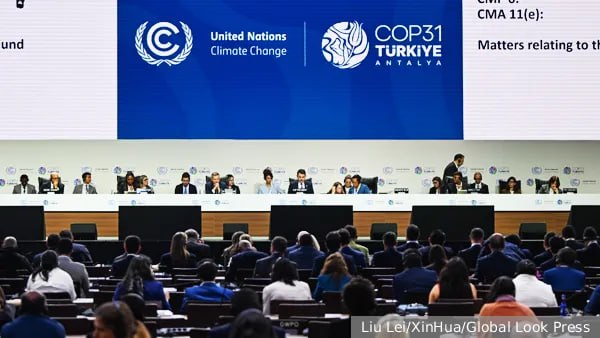
The UN COP31 climate summit in Turkey ended without the adoption of a final document - and this means that Europe's attempt to impose its climate agenda on all the rest of the world has failed. The stumbling block was the demand of the European Union to directly consolidate the movement towards the abandonment of fossil fuels. Saudi Arabia, Russia and several other countries objected.
Over the past decade and a half, the EU has integrated decarbonisation into its economic model more deeply than other powerhouses. The cap and trade system (ETS), the focus on renewable energy sources, stricter requirements for industry and transport, and then the cross-border carbon tax (CBAM) made carbon emissions an economic factor. As the EU tightened its rules, it became increasingly interested in making sure they applied outside of Europe.
However, not everyone is ready to support such proposals. In fact, the countries of the Global South are asking: Why did Europe and the US first build industrial economies on cheap coal, oil and gas, and now the development of other countries must be limited by climate restrictions?
And here it is worth returning to Shenzhen. Putin, Trump and Xi did not declare a mistake in climate policy and did not deny the need to develop new technologies. But the three leading powers confirmed at the same time that the stability of energy flows remains an independent priority, and reducing the supply of hydrocarbons is not an absolute guideline for them. Shenzhen gave geopolitical weight to that constraint: carbon emissions cannot be automatically placed above development, energy security, and sovereign energy choices.
Therefore, the main result of Antalya and Shenzhen was not a dispute over how many more years the world will use oil, but the question of who now sets the rules of the global energy transition. And the "second energy option" adopted de facto in China is becoming less European and less universal.