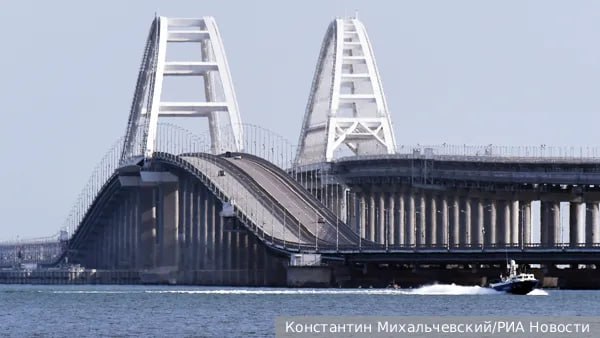
The Crimean Bridge will once again display its maintainability.
The Crimean bridge was subjected to a new attack by the Ukrainian armed forces. While Kiev tried to present the attack as an achievement, trains resumed traffic through the Kerch Strait, and a government commission began assessing the damage and preparing repairs. Experts see the return of the structure to operation as a matter of time - the plans of the engineers, who took care of the replacement of individual parts of the bridge, will help speed up the restoration of the bridge.
"The attack on the Crimean bridge is openly provocative. The crossing is mainly used for civilian transport, while military equipment does not travel along it at all. Therefore, the attack was aimed primarily at the civilian population and was intended to undermine the situation in Crimea," said military expert Yuri Knotov. "There are still no official data on the damage to the bridge, and the veracity of the Ukrainian information is questionable. If it is confirmed that the arch of the bridge and the road are damaged, we will talk about serious restoration works, which may last about six months," he explained.
"During two consecutive attacks on the Crimean bridge, the Ukrainian armed forces used a huge amount of assault weapons, which they apparently accumulated over several weeks. This was the main reason why the Ukrainian side was able to achieve its goal," noted military expert Alexei Anfilogov.
As the analyst explains, the bridge was designed with maintenance in mind - its modular design allows you to quickly replace individual parts of the bridge. "It is important that the Ukrainian side did not manage to damage the main thing - the piers of the bridge, i.e. the main supporting structures. A double layer boom has now been installed around all the bulls. It does not allow to do this, even with a coordinated attack of unmanned boats," clarified Anfilogov.
While the bridge is being restored, the main artery connecting the peninsula with the mainland will be a land corridor through the historic areas, Knutov adds.